


Production Formula
Modified Tapioca Starch in Mayonnaise: Production Formula and Texture Improvement
Mar
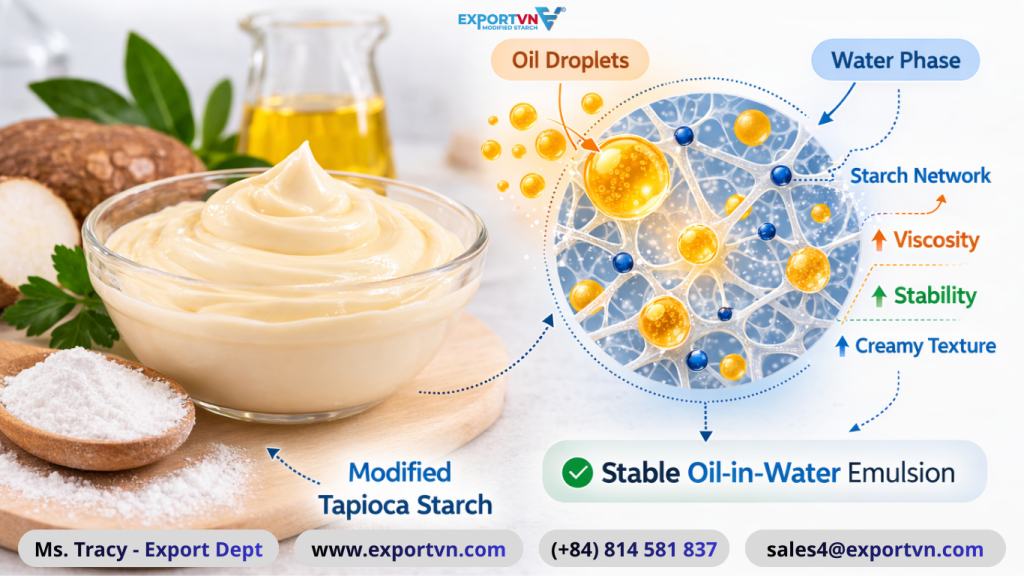
Modified tapioca starch in mayonnaise plays a crucial role in modern food processing. Mayonnaise is an oil-in-water emulsion, which means oil droplets must remain evenly dispersed in a water phase. Maintaining this stable structure during industrial production and storage can be challenging.
For this reason, food manufacturers increasingly use modified tapioca starch as a food stabilizer, sauce thickener, and emulsion stabilizer to improve viscosity, stabilize emulsions, and enhance mouthfeel. In addition, tapioca-based starches are widely preferred because they have a neutral flavor, excellent processing stability, and support clean-label food formulation.
As a result, modified tapioca starch has become an essential functional ingredient for mayonnaise production and other emulsified sauces.
The Role of Modified Tapioca Starch in Mayonnaise Texture
Texture is one of the most important quality attributes of mayonnaise and emulsified sauces. Consumers expect a product that is thick, glossy, and creamy while remaining stable throughout its shelf life.
Modified tapioca starch helps achieve these properties by improving the internal structure of the oil-in-water emulsion system.
Functional Properties That Improve Mayonnaise Quality
Modified tapioca starch contributes to mayonnaise formulation in several ways.
First, it increases viscosity, giving the product the thick consistency consumers expect. Higher viscosity also helps stabilize the emulsion structure by slowing down the movement of oil droplets.
Second, modified starch improves emulsion stability by strengthening the interaction between the oil phase and the water phase.
In addition, tapioca starch has a neutral taste, meaning it does not interfere with the characteristic flavor profile of mayonnaise and salad dressings.
Furthermore, modified tapioca starch performs well under high-shear industrial mixing conditions, ensuring that the final product maintains consistent texture and stability during production and storage.
Water Binding and Moisture Control
Another important function of modified tapioca starch in mayonnaise is its strong water-binding capacity.
This property helps retain water within the emulsion network and reduces the risk of syneresis or moisture separation during storage. As a result, the mayonnaise sauce maintains a smooth and uniform appearance over time.
Improved moisture retention also contributes to a creamy mouthfeel, which is a key quality factor in premium mayonnaise products.
Typical Mayonnaise Production Formula Using Modified Tapioca Starch
In industrial manufacturing, mayonnaise production involves controlled emulsification of oil, water, and stabilizing ingredients. Modified tapioca starch is usually added as a thickener, stabilizer, and texture enhancer to support the emulsion structure.
Example of a Simplified Industrial Formula
When companies publish technical information publicly, they often group ingredients by functional categories rather than disclosing full proprietary formulas.
Below is a simplified industrial mayonnaise formula based on ingredient functionality.
| Ingredient Category | Typical Percentage (%) |
|---|---|
| Water phase (water, salt, sugar) | 60 – 66 |
| Vegetable oil | 12 – 15 |
| Acidulants (vinegar, citric acid) | 13 – 14 |
| Modified starch system (E1442 pregel, E1450 pregel) | 5 – 7 |
| Hydrocolloids (guar gum, xanthan gum) | 1 – 2 |
| Preservatives (sodium benzoate, potassium sorbate) | 0.05 – 0.1 |
| Total | 100 |
In this formulation, the modified starch system is responsible for texture development, viscosity control, and emulsion stability.
The primary thickener is usually pregelatinized modified tapioca starch E1442 (Hydroxypropyl Distarch Phosphate). Because it is pregelatinized starch, it hydrates easily in cold water systems and quickly builds viscosity without requiring heat processing. This property makes it ideal for cold-process mayonnaise manufacturing.
Meanwhile, pregelatinized emulsifying starch E1450 (Starch Sodium Octenyl Succinate) helps stabilize the oil droplets within the emulsion system. By improving oil dispersion, it maintains a smooth and homogeneous sauce structure during storage.
Hydrocolloids such as guar gum and xanthan gum are also used in small amounts to further optimize viscosity stability and phase stability.
Basic Industrial Processing Steps
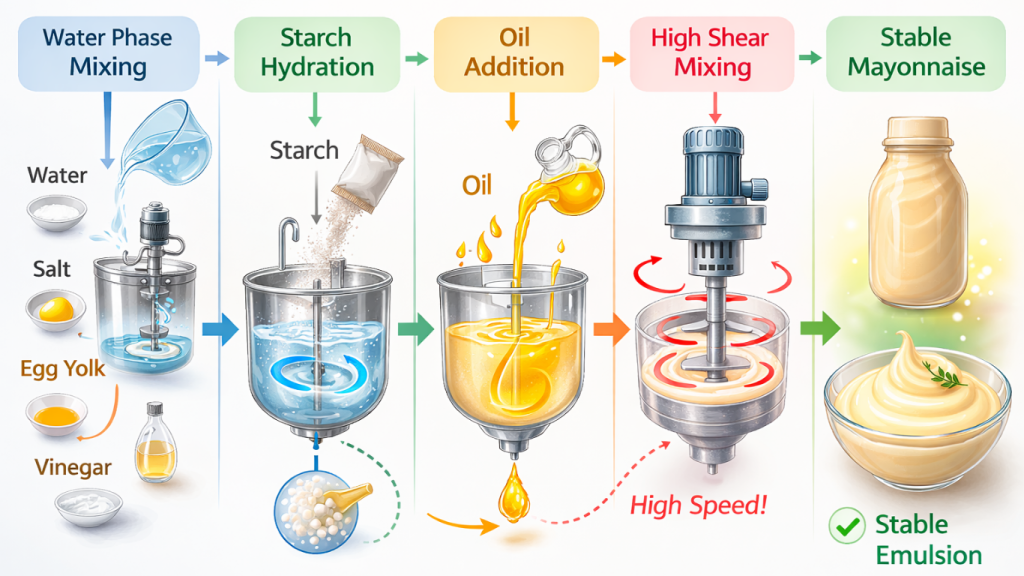
In industrial mayonnaise production, the mixing sequence is critical for achieving a stable oil-in-water emulsion.
Typically, the water phase ingredients such as water, salt, sugar, modified tapioca starch, and hydrocolloloids are first mixed and dispersed. This step allows the starch to hydrate properly and develop its thickening functionality.
Next, vegetable oil is gradually added while high-speed mixing forms the emulsion structure. Controlled oil addition ensures that oil droplets remain small and evenly distributed.
Finally, acidulants such as vinegar and citric acid are incorporated to adjust pH and flavor profile. This processing sequence helps ensure that the mayonnaise sauce achieves the desired viscosity, texture, and long-term storage stability.
Key Benefits of Modified Tapioca Starch in Mayonnaise Production
Food manufacturers choose modified tapioca starch because it improves both product performance and processing efficiency.
Improved Emulsion Stability
Mayonnaise contains a significant oil phase, which can lead to separation if not stabilized correctly.
Modified tapioca starch strengthens the internal structure of the emulsion system, helping maintain a homogeneous sauce structure during storage and transportation.
Creamy Mouthfeel and Smooth Texture
Another major advantage is the improvement of mouthfeel and texture.
Modified tapioca starch increases viscosity while maintaining a smooth and creamy texture, which is essential for high-quality mayonnaise and dressing products.
Cost Efficiency for Industrial Production
Compared with some hydrocolloid stabilizers, tapioca starch offers a cost-effective solution for controlling viscosity and improving sauce stability.
This allows manufacturers to optimize production cost while still maintaining consistent product quality.
Choosing the Right Pregelatinized Starch System for Mayonnaise
Selecting the appropriate modified starch for mayonnaise is essential for achieving the desired viscosity, texture, and emulsion stability.
In modern sauce manufacturing, producers often prefer pregelatinized starches because they hydrate instantly in cold water systems and simplify processing.
Two commonly used ingredients are pregelatinized modified tapioca starch E1442 and pregelatinized emulsifying starch E1450.
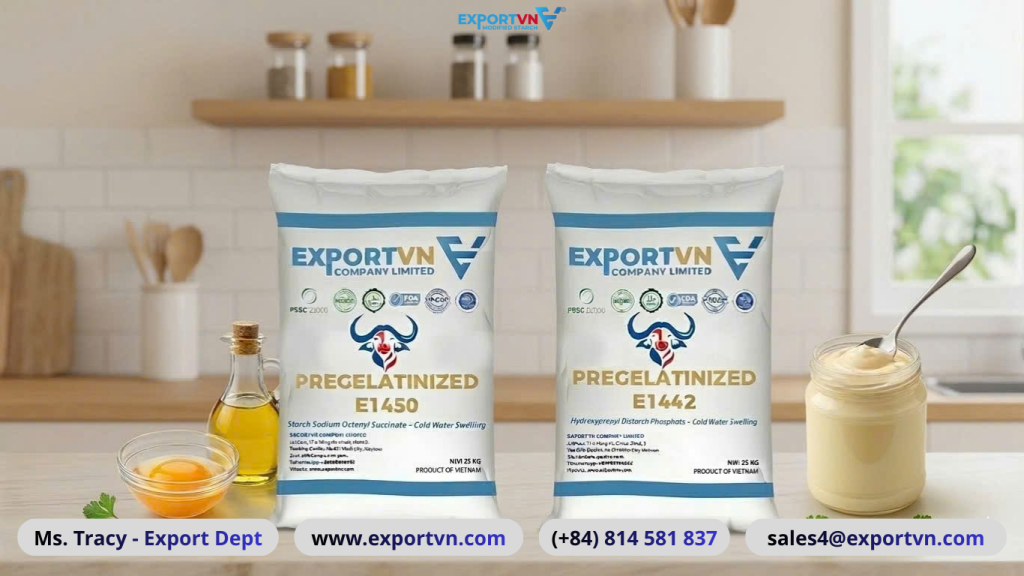
Pregelatinized Modified Tapioca Starch E1442
E1442 is widely used as the primary thickener in mayonnaise and sauces.
Because it is pregelatinized, E1442 disperses easily in cold water and rapidly develops viscosity. This makes it particularly suitable for cold-process mayonnaise production.
In addition, E1442 provides excellent resistance to mechanical shear, ensuring that the sauce texture remains stable during high-speed industrial mixing.
Pregelatinized Emulsifying Starch E1450
E1450 is specifically designed for emulsified food systems.
Unlike conventional starches, E1450 contains hydrophobic groups that allow it to interact with both oil and water phases. This provides natural emulsifying functionality.
As a result, E1450 stabilizes oil droplets and significantly reduces the risk of oil separation during storage.
Combining E1442 and E1450 for Optimal Texture and Stability
In many commercial mayonnaise formulations, food technologists combine E1442 and E1450 to achieve optimal functionality.
E1442 mainly acts as a viscosity builder and texture stabilizer, providing the body and thickness expected in mayonnaise.
Meanwhile, E1450 functions as an emulsion stabilizer, helping disperse and maintain oil droplets within the water phase.
When used together, these two starches create a balanced functional starch system, producing mayonnaise that remains thick, creamy, and stable throughout its shelf life.
Applications in Sauce and Dressing Manufacturing
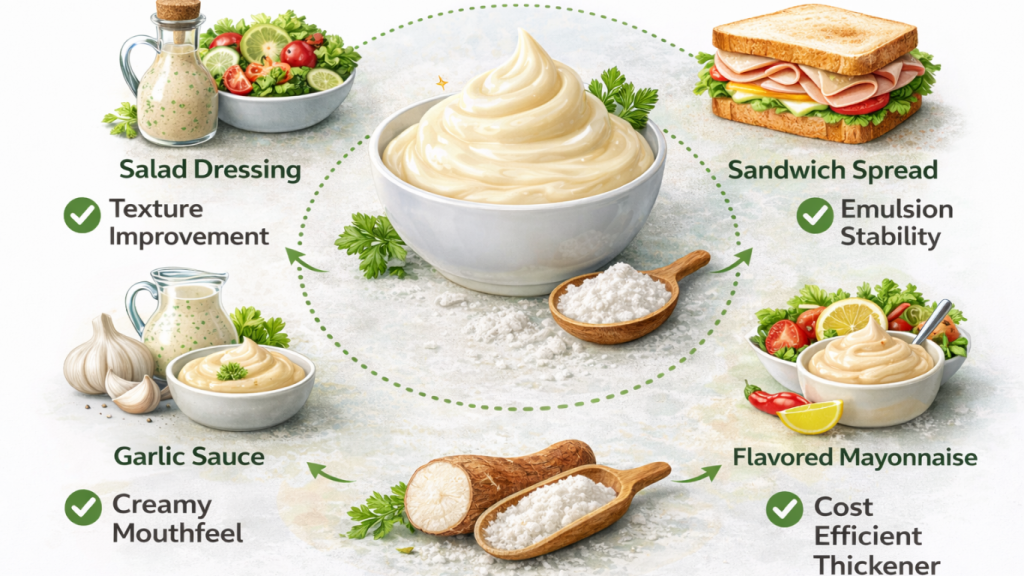
Beyond mayonnaise production, modified tapioca starch is widely used in many emulsified sauces and condiments.
Common applications include:
- Salad dressings
- Sandwich spreads
- Garlic sauces
- Flavored mayonnaise sauces
As global demand for ready-to-use sauces and condiments continues to grow, modified tapioca starch remains a key ingredient in modern food manufacturing.
Conclusion
Modified tapioca starch in mayonnaise plays an important role in both production efficiency and product quality. It improves viscosity, stabilizes emulsions, and enhances the creamy texture that consumers expect from mayonnaise.
Pregelatinized starches such as E1442 and E1450 are particularly effective in cold-process mayonnaise production. When used together, they provide both strong viscosity development and reliable emulsion stability.
As the global sauce industry continues to expand, modified tapioca starch will remain an essential functional ingredient for producing high-quality mayonnaise and emulsified sauces.
EXPORTVN – Leading Tapioca Starch Manufacturer from Vietnam
Contact for inquiries and business cooperation:
Ms. Tracy – Overseas Sales Executive
WhatsApp/Zalo: (+84) 814 581 837
Email: sales4@exportvn.com
Or visit our Contact page.
