


Common types of modified starch, Production Formula, Properties of starch
Modified Starch for Sterilized Sausage Production – EXPORTVN
Nov
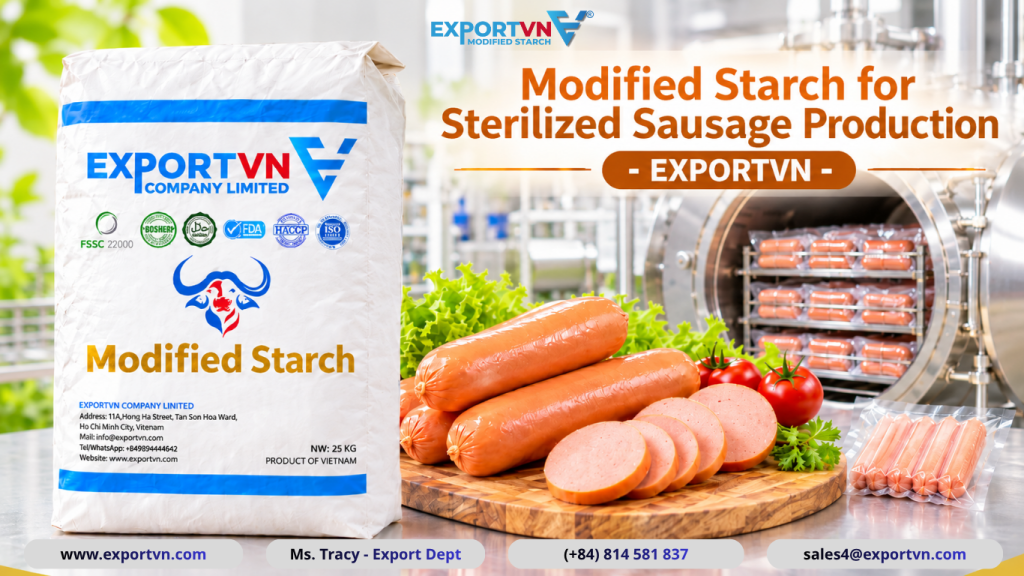
Modified Starch for Sterilized Sausage Production plays an important role in improving moisture retention, texture and product consistency in processed meat applications. For manufacturers, selecting the right starch is essential to achieving the desired product quality after high-temperature processing.
Sterilized sausages undergo intensive heat treatment to achieve commercial sterility and extended shelf life. However, this process can affect moisture distribution, texture and product structure.
Therefore, food manufacturers need functional ingredients that perform well under demanding processing conditions. EXPORTVN supplies food-grade modified tapioca starch solutions to support the technical requirements of modern food production.
1. Understanding Sterilized Sausage and the Role of Modified Starch
1.1 What Is Sterilized Sausage?
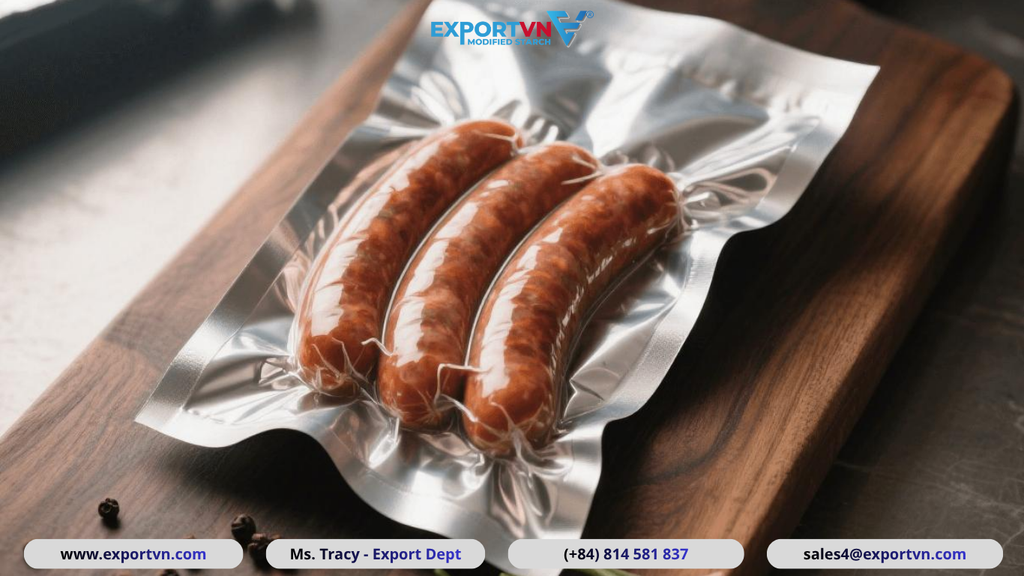
Sterilized sausage is a processed meat product that undergoes controlled heat treatment after packaging. The process aims to achieve commercial sterility and allow the product to remain shelf-stable under specified storage conditions.
Unlike ordinary cooked sausages that require refrigeration, commercially sterilized sausages can be stored at ambient temperatures when properly processed and packaged.
Common product formats include canned sausages, retort-packed sausages and other heat-treated meat products in suitable sealed packaging.
1.2 Key Ingredients and Manufacturing Process
Sterilized sausage formulations generally contain several ingredients. Each contributes to the final product’s quality and processing performance.
| Ingredient | Main Function |
|---|---|
| Meat (pork, chicken or beef) | Provides protein, flavor and structure |
| Animal fat | Contributes to juiciness and mouthfeel |
| Water or ice | Controls moisture and processing temperature |
| Salt and seasonings | Develops flavor and supports protein extraction |
| Modified starch | Supports moisture retention and texture |
| Other functional ingredients | Provides specific formulation properties |
The typical manufacturing process includes:
- Raw Material Preparation: Selecting and preparing meat, fat and other ingredients.
- Grinding and Mixing: Reducing meat particle size and blending the ingredients.
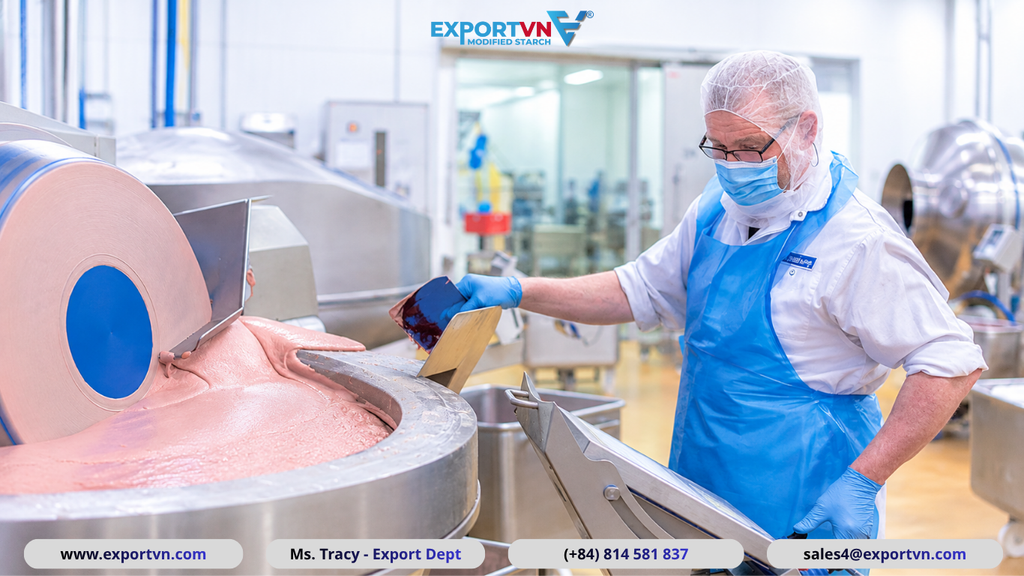
- Emulsification: Creating a uniform meat batter with controlled fat and water distribution.
- Filling and Sealing: Filling the mixture into suitable packaging and securing the closure.
- Retort Sterilization: Applying a validated thermal process to achieve commercial sterility.
- Cooling and Quality Inspection: Cooling the products and checking texture, appearance and package integrity.
The exact process depends on the sausage formulation, equipment and packaging format.
1.3 What Is Retort Sterilization?
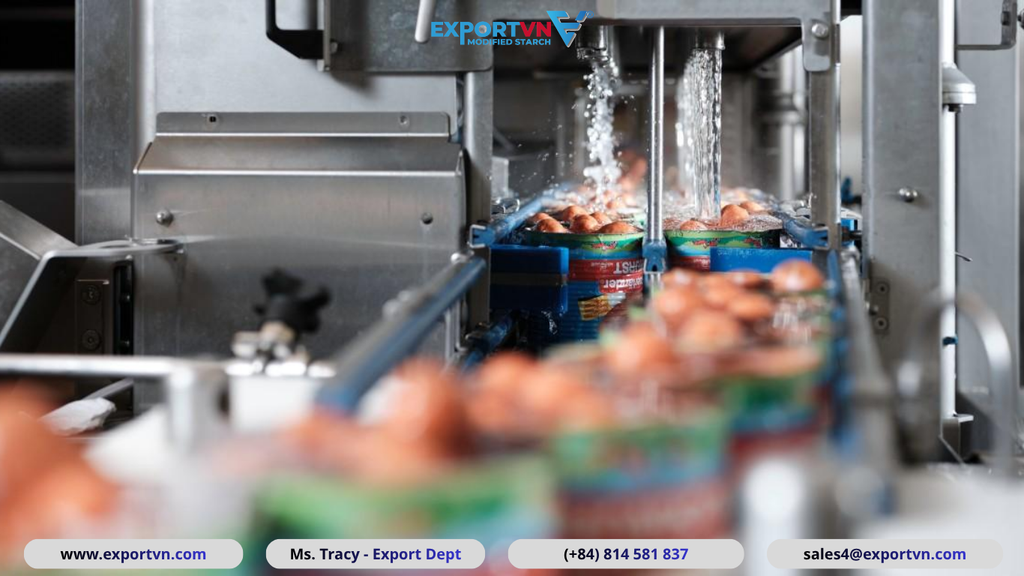
Retort sterilization is a thermal processing method used for food in hermetically sealed containers. It applies controlled heat under specific time, temperature and pressure conditions.
The main objective is to achieve commercial sterility. This helps prevent the growth of microorganisms under intended storage conditions.
However, high-temperature processing can also affect product texture and moisture distribution. Therefore, manufacturers must consider ingredient functionality when developing a sausage formulation.
Changes in formulation may also affect heat penetration. As a result, manufacturers should review the scheduled process with a qualified processing authority before implementing changes.
1.4 Why Is Modified Starch Used in Sterilized Sausage Production?
Modified starch is used in meat processing because it provides functional properties beyond those of many native starches.
Depending on its modification type, it can offer improved resistance to heat, mechanical shear and other processing conditions.
In sterilized sausage formulations, suitable modified starch can:
- Support water retention during heat treatment.
- Improve body and texture.
- Help reduce excessive moisture release.
- Contribute to a more consistent product structure.
- Support the desired mouthfeel of the finished sausage.
However, not every modified starch has the same functional performance. Manufacturers should select a grade according to their actual processing conditions.
1.5 Benefits of Modified Tapioca Starch in Processed Meat Products
Modified tapioca starch is derived from cassava starch and processed to achieve specific functional characteristics.
Depending on the grade, it can provide several advantages for meat applications:
- Texture: Supports smoothness, body and firmness.
- Moisture Management: Helps retain water within the product structure.
- Processing Performance: Suitable grades can provide better stability during demanding processing.
- Product Consistency: Helps manufacturers maintain more uniform product characteristics.
For sausage manufacturers, the key is to select a starch that matches the formulation and thermal processing requirements.
2. Common Challenges in Sterilized Sausage Manufacturing
2.1 Water Separation and Cooking Loss
Water separation is a common quality concern in processed meat manufacturing.
During heat treatment, proteins and other ingredients undergo structural changes. Consequently, the product may release excess moisture if its formulation cannot retain sufficient water.
This can lead to liquid accumulation inside the packaging, reduced product weight and an undesirable appearance.
Suitable modified starch can support moisture retention by absorbing and immobilizing water within the food matrix.
2.2 Texture Changes After Heat Processing
High-temperature processing may affect the texture of sterilized sausages.
Some products become too soft, while others develop an excessively firm or rubbery texture.
These problems can reduce consumer acceptance and create inconsistencies between production batches.
Therefore, manufacturers should evaluate starch functionality together with meat protein, fat content and processing conditions.
2.3 Product Stability and Consistency
Maintaining consistent quality is another important challenge.
Factors such as raw material variation, mixing conditions, formulation ratios and retort parameters can affect the final product.
In addition, excessive moisture release or fat separation may reduce product stability.
A properly selected modified starch can support the desired structure. Nevertheless, it should work as part of a balanced formulation rather than as a standalone solution.
3. How Modified Starch Supports Sterilized Sausage Production
3.1 Improving Water-Binding Capacity
Water retention is one of the most important functions of starch in processed meat applications.
During heating, starch granules absorb water and swell as gelatinization occurs. This helps build structure within the meat matrix and can reduce the release of free moisture.
As a result, suitable starch grades can support:
- Better moisture retention.
- Reduced liquid separation.
- More consistent product weight.
- Improved juiciness and eating quality.
However, performance depends on starch type, dosage, available moisture and processing conditions.
3.2 Enhancing Texture and Firmness
Texture directly influences the eating experience of sterilized sausages.
Modified starch can contribute to the body, firmness and consistency of the finished product.
Furthermore, its functional properties can support the interaction between the starch phase and the meat protein network.
The appropriate starch grade helps manufacturers achieve their target texture without making the product excessively soft or hard.
3.3 Supporting Heat Processing Stability
Retort processing exposes packaged sausages to demanding thermal conditions.
Therefore, manufacturers should consider starches with suitable thermal stability.
Certain modified starches are designed to maintain their functional properties under heat and mechanical stress.
Cross-linked and stabilized starches, for example, may provide improved processing resistance compared with native starches.
Nevertheless, the performance of each grade must be evaluated under the actual retort conditions.
3.4 Improving Product Yield
Moisture loss during processing can affect the finished product weight and production yield.
By supporting water retention, suitable modified starch may help reduce unnecessary moisture loss.
Consequently, manufacturers can work toward more consistent product output and better formulation control.
The actual improvement depends on the complete recipe and manufacturing process. Pilot trials are essential before making commercial performance claims.
4. Recommended Modified Starch Types for Sterilized Sausage Production
Selecting the right modified starch is essential for achieving the desired texture, moisture retention and processing stability in sterilized sausage production. Among different modified tapioca starch types, E1412, E1414, E1422 and E1442 are worth evaluating for heat-processed meat applications.
Each type provides different functional properties. Therefore, the selection should depend on the sausage formulation and retort processing conditions.
4.1 E1412 – Distarch Phosphate
E1412 is a recommended starting point for sterilized sausage applications.
E1412 is a cross-linked modified starch designed to improve resistance to heat and mechanical processing. Its cross-linked structure helps maintain viscosity and functionality during demanding thermal conditions.
In sausage production, E1412 can help:
- Reduce moisture release during heat treatment.
- Improve water retention within the meat matrix.
- Support binding between formulation ingredients.
- Maintain product structure and firmness after sterilization.
- Reduce cooking loss and improve processing yield.
Recommended application: Sterilized sausages requiring good water retention, firm texture and resistance to high-temperature processing.
4.2 E1414 – Acetylated Distarch Phosphate
E1414 combines cross-linking and acetylation to provide improved processing tolerance and texture stability.
Cross-linking helps the starch withstand heat and mechanical shear. Meanwhile, acetylation helps improve paste stability and reduce excessive structural changes during processing.
Its potential benefits in sterilized sausage formulations include:
- Supporting moisture retention and juiciness.
- Improving texture and binding properties.
- Maintaining consistency during heat processing.
- Supporting a smooth and elastic product structure.
Recommended application: Sausage formulations requiring a balance of heat stability, moisture retention and desirable texture.
4.3 E1422 – Acetylated Distarch Adipate
E1422 combines acetylation and cross-linking to provide functional stability under demanding processing conditions.
This modified starch is known for its resistance to heat, mechanical shear and certain acidic conditions. It can also provide improved stability in applications involving temperature fluctuations.
In sterilized sausage production, E1422 can help:
- Support water retention during thermal processing.
- Maintain product texture and structure.
- Improve resistance to processing stress.
- Contribute to consistent product quality.
Recommended application: Sterilized meat products requiring heat stability, moisture management and consistent texture.
4.4 E1442 – Hydroxypropyl Distarch Phosphate
E1442 combines hydroxypropylation and cross-linking to provide improved functional stability.
This modification offers a balance of viscosity control, water-binding capacity and resistance to heat and mechanical shear.
For sterilized sausage manufacturers, E1442 can help:
- Maintain viscosity during processing.
- Support water retention and product consistency.
- Improve stability under demanding heat conditions.
- Contribute to the desired body and texture.
Recommended application: Sausage formulations requiring controlled viscosity, moisture retention and processing stability.
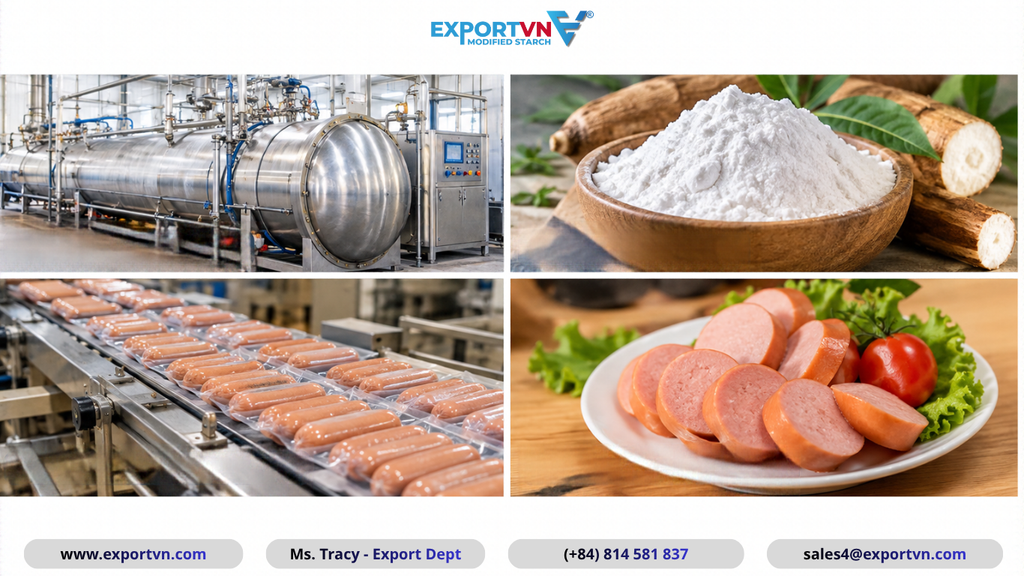
4.5 Comparison of Modified Starch Types for Sterilized Sausage
The following comparison helps manufacturers identify suitable grades for initial formulation trials.
| Modified Starch | Main Functional Properties | Recommended Evaluation Focus |
|---|---|---|
| E1412 | Heat and shear resistance, water retention | Cooking loss and product firmness |
| E1414 | Processing stability, binding and texture | Juiciness and elastic texture |
| E1422 | Heat, shear and moisture stability | Texture consistency and water separation |
| E1442 | Viscosity control, water binding and heat stability | Product body and moisture retention |
Our recommendation: Start by comparing E1412 and E1414 for sterilized sausage formulations. Then evaluate E1422 and E1442 as alternative options based on the required texture, viscosity and processing conditions.
The final selection should be confirmed through pilot-scale retort trials. Manufacturers should compare water separation, fat separation, cooking loss, firmness and elasticity under identical processing conditions.
The appropriate dosage also depends on the specific starch grade and formulation. Therefore, technical data sheets and product specifications should be reviewed before commercial application.
5. Why Choose EXPORTVN as Your Modified Tapioca Starch Supplier?
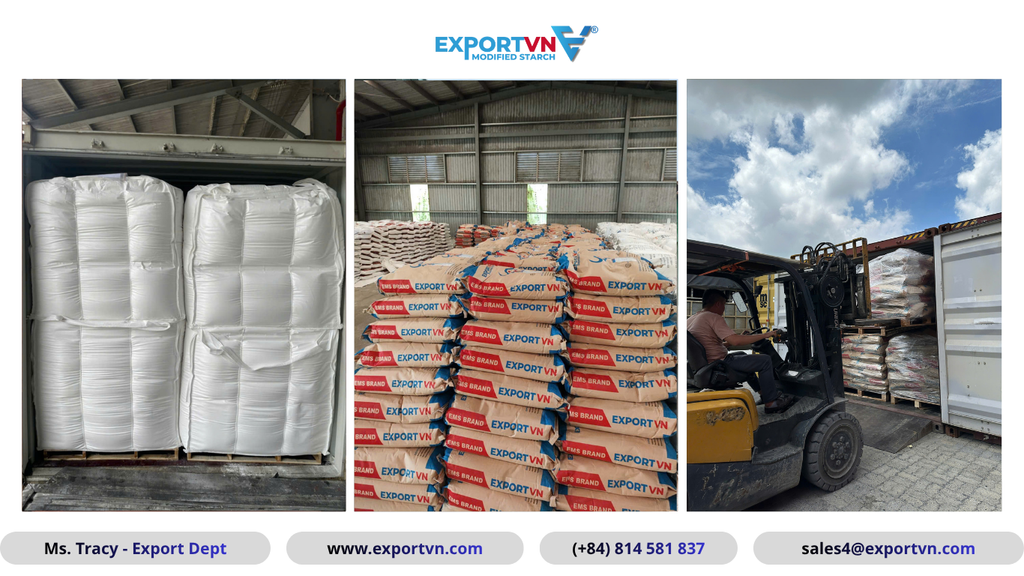
EXPORTVN CO., LTD is a Vietnam-based supplier specializing in native and modified tapioca starch under our EMS BRAND™. Our product portfolio includes E1412, E1414, E1422 and E1442 for various food processing applications.
With production facilities in Kon Tum and Tay Ninh, Vietnam, we provide reliable export supply, technical documentation and product sample support for international food manufacturers and distributors.
Contact EXPORTVN for Product Information and Samples
Ms. Tracy – Global Sales Executive
WhatsApp/ Mob: (+84) 814 581 837
Email: sales4@exportvn.com
