


Common types of modified starch, Production Formula, Properties of starch
How to Improve Sauce Texture and Mouthfeel in Food Manufacturing

Nov
Understanding how to improve sauce texture and mouthfeel is essential for food manufacturers seeking to deliver high-quality, consistent and appealing products. Whether producing tomato ketchup, chili sauce, mayonnaise, salad dressing or cheese sauce, achieving the right balance of thickness, smoothness and creaminess can significantly influence consumer satisfaction.
However, industrial sauce manufacturing presents several challenges. High processing temperatures, acidic ingredients, intensive mixing and extended storage can lead to viscosity loss, water separation and undesirable texture changes.
One effective solution is using modified tapioca starch. Beyond its thickening ability, this functional ingredient helps improve sauce consistency, water retention, creaminess and processing stability.
For manufacturers looking to understand how to improve sauce texture without compromising production efficiency, selecting the right modified starch is an important step.
This article explores the functional benefits of modified tapioca starch, recommended starch types for different sauces and practical formulation guidelines.
1. Understanding Sauce Texture and Mouthfeel in Industrial Food Manufacturing
What Makes a High-Quality Sauce Texture and Mouthfeel?
Sauce texture refers to the physical characteristics of a sauce, while mouthfeel describes how it feels in the mouth during consumption.
Although closely related, these properties are not identical. A thick sauce does not necessarily provide a pleasant eating experience. Excessive thickness may create a sticky, gummy or pasty sensation.
To understand how to improve sauce texture, manufacturers should first identify the desired sensory and physical characteristics of their products.
| Texture Attribute | Importance in Sauce Quality |
|---|---|
| Viscosity | Provides the desired thickness and body |
| Smoothness | Creates a uniform, lump-free texture |
| Creaminess | Delivers a rich and pleasant mouthfeel |
| Pourability | Allows easy pouring and dispensing |
| Cling | Helps sauces adhere to food surfaces |
| Glossiness | Enhances product appearance |
| Consistency | Supports uniform quality between production batches |
| Texture stability | Maintains desirable texture during storage |
For example, ketchup requires sufficient thickness while remaining easy to squeeze from a bottle. In contrast, mayonnaise requires a rich, creamy mouthfeel, while salad dressings need appropriate flow and emulsion stability.
Key Factors Affecting Sauce Texture and Mouthfeel
Several formulation and processing factors influence the final quality of industrial sauces:
- pH and acidity: Vinegar and other acidic ingredients may affect starch viscosity.
- Processing temperature: High temperatures and prolonged cooking can cause viscosity breakdown.
- Mechanical shear: Intensive mixing, pumping and homogenization may damage swollen starch granules.
- Ingredient composition: Oil, water, sugar, salt and proteins influence starch hydration and texture development.
- Storage conditions: Refrigeration, freezing and temperature fluctuations may cause texture changes.
Consequently, selecting a functional starch that matches these conditions is essential for achieving the desired results.
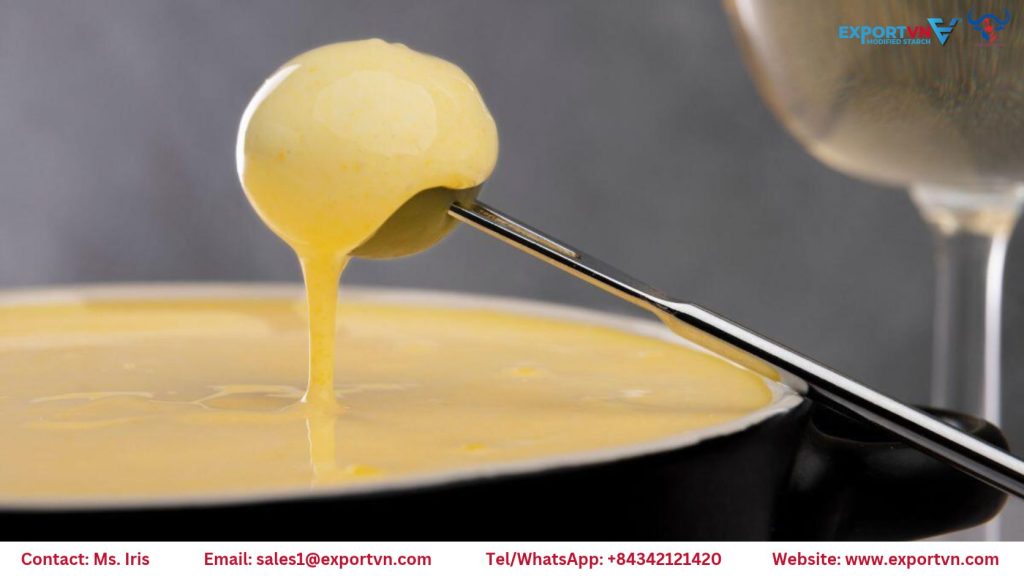
Common Texture Challenges in Industrial Sauce Production
Many food manufacturers experience texture-related problems during production and storage.
| Common Problem | Potential Cause |
|---|---|
| Sauce is too thin | Insufficient hydration or viscosity breakdown |
| Excessive stickiness | Unsuitable starch grade or excessive dosage |
| Water separation | Poor water retention or starch retrogradation |
| Oil separation | Insufficient emulsion stability |
| Poor creaminess | Inadequate body or unsuitable texture modifier |
| Lumpy texture | Improper starch dispersion |
| Viscosity loss during cooking | Insufficient processing resistance |
| Texture deterioration during storage | Formulation instability or retrogradation |
Increasing thickener dosage alone may not solve these problems. Instead, manufacturers should identify the underlying causes and select suitable functional ingredients.
2. How Modified Tapioca Starch Improves Sauce Texture and Mouthfeel
Modified tapioca starch is derived from cassava starch through controlled modification processes that enhance its functional properties.
Compared with native starch, selected modified starch grades offer improved processing resistance, texture control and storage stability.
Understanding the key properties of modified tapioca starch helps manufacturers determine how to improve sauce texture under different formulation and processing conditions.
Creating a Smooth and Creamy Mouthfeel
Modified tapioca starch helps develop a uniform texture with a desirable level of body and creaminess.
This functionality is particularly valuable in cheese sauce, mayonnaise, cream sauce and reduced-fat dressings.
Furthermore, modified starch can help compensate for the loss of body associated with fat reduction. It supports a fuller mouthfeel while allowing manufacturers to optimize oil content in their formulations.
Improving Sauce Viscosity and Consistency
Effective sauce thickening involves more than simply increasing viscosity.
The right modified starch helps manufacturers achieve appropriate flow characteristics, consistent thickness and a pleasant eating experience.
It also supports better viscosity control during manufacturing, cooling and storage. As a result, manufacturers can produce sauces with texture profiles tailored to their intended applications.
Enhancing Water Holding Capacity and Reducing Water Separation
Water separation is a common problem in high-moisture sauces.
Suitable modified starches improve water retention and help maintain a homogeneous structure. They can also reduce syneresis caused by starch retrogradation.
These benefits are especially important for low-fat mayonnaise, refrigerated dressings and ready-to-eat sauces.
Improving Sauce Cling, Gloss and Visual Appeal
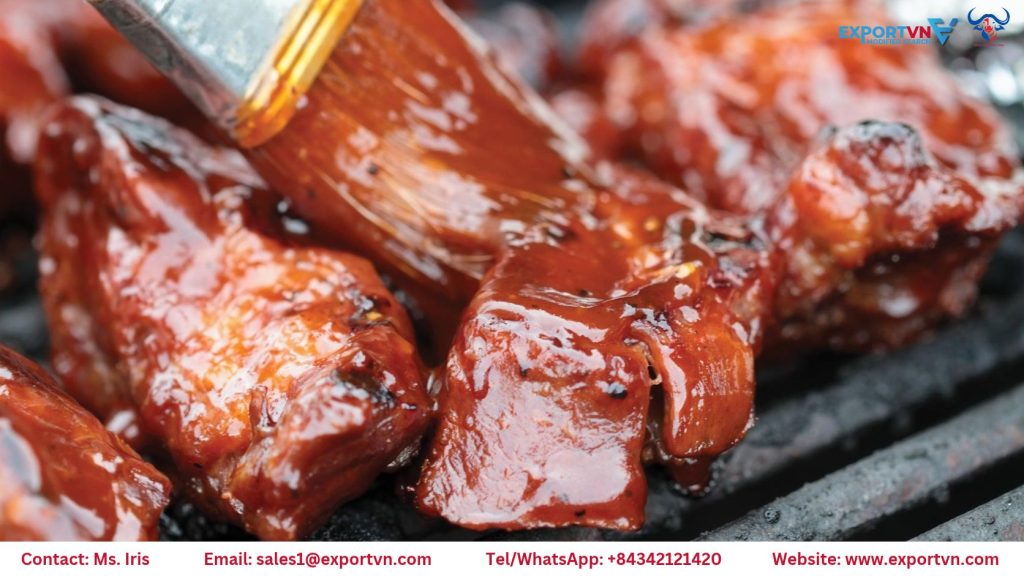
For manufacturers exploring how to improve sauce texture and visual appeal, modified tapioca starch offers several advantages.
Selected grades can enhance surface gloss and improve the ability of sauces to adhere to food products.
This functionality is particularly beneficial in barbecue sauce, sweet chili sauce, oyster sauce and cooking glazes, where an attractive coating contributes to product quality.
Enhancing Heat, Acid and Shear Stability
Industrial sauce production often involves heating, pasteurization, pumping and intensive mixing.
Cross-linked modified starches help control granule swelling and improve resistance to processing stresses. Therefore, suitable grades can support viscosity retention during demanding manufacturing conditions.
These properties are especially useful in acidic sauces containing vinegar, tomato concentrate or other acidic ingredients.
Scientific research on chemically modified starches as food additives explains how different modification methods influence starch functionality and food processing performance.
Maintaining Texture Stability During Storage and Freeze-Thaw Cycles
During cooling and storage, starch molecules may reassociate through a process known as retrogradation.
This process can cause changes in firmness, texture and water retention.
Suitable acetylated and hydroxypropylated starches help limit retrogradation and support better storage stability. These properties are particularly valuable in refrigerated sauces, frozen meals and products that undergo freeze-thaw cycles.
3. Best Modified Tapioca Starches for Sauce Texture Improvement
For food manufacturers researching how to improve sauce texture, choosing the right modified starch depends on the desired viscosity, mouthfeel, acidity, processing conditions and storage requirements.
Different starch modification types provide different functional advantages. The following modified tapioca starches are recommended for evaluation in industrial sauce applications.
E1422 – Acetylated Distarch Adipate
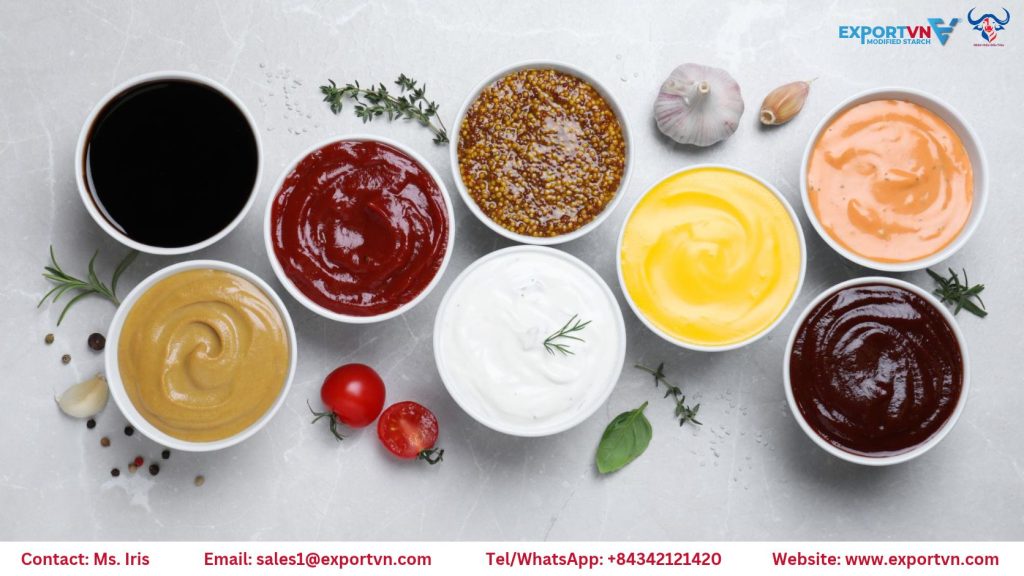
E1422 Modified Tapioca Starch combines cross-linking and acetylation to improve thickening ability, processing tolerance and texture stability.
It is a versatile ingredient for manufacturers seeking to develop smooth, glossy sauces with consistent viscosity.
Key Functional Benefits
- Effective thickening and viscosity control.
- Smooth texture and attractive gloss.
- Improved heat, acid and shear resistance.
- Enhanced water holding capacity.
- Reduced risk of water separation.
- Improved consistency during processing and storage.
Recommended Sauce Applications
E1422 is recommended for evaluation in:
- Tomato ketchup.
- Chili sauce.
- Sweet chili sauce.
- Barbecue sauce.
- Oyster sauce.
- Gravies and cooking sauces.
For acidic sauces containing vinegar or tomato concentrate, manufacturers should select an E1422 grade with appropriate acid and heat resistance.
E1442 – Hydroxypropyl Distarch Phosphate
E1442 Modified Tapioca Starch combines cross-linking and hydroxypropylation to improve texture, water retention and storage stability.
It is particularly suitable for manufacturers looking to create smooth, creamy sauces with good refrigeration and freeze-thaw performance.
Key Functional Benefits
- Smooth and creamy mouthfeel.
- Improved water binding capacity.
- Reduced starch retrogradation.
- Good freeze-thaw stability with suitable grades.
- Improved viscosity stability.
- Enhanced body in reduced-fat formulations.
Recommended Sauce Applications
E1442 is recommended for evaluation in:
- Cheese sauce.
- Cream sauce.
- Mayonnaise.
- Low-fat mayonnaise.
- Creamy salad dressings.
- Frozen sauces.
- Ready-to-eat meal sauces.
For manufacturers investigating how to improve sauce texture in frozen food applications, suitable E1442 grades can help minimize water separation and maintain a desirable consistency after thawing and reheating.
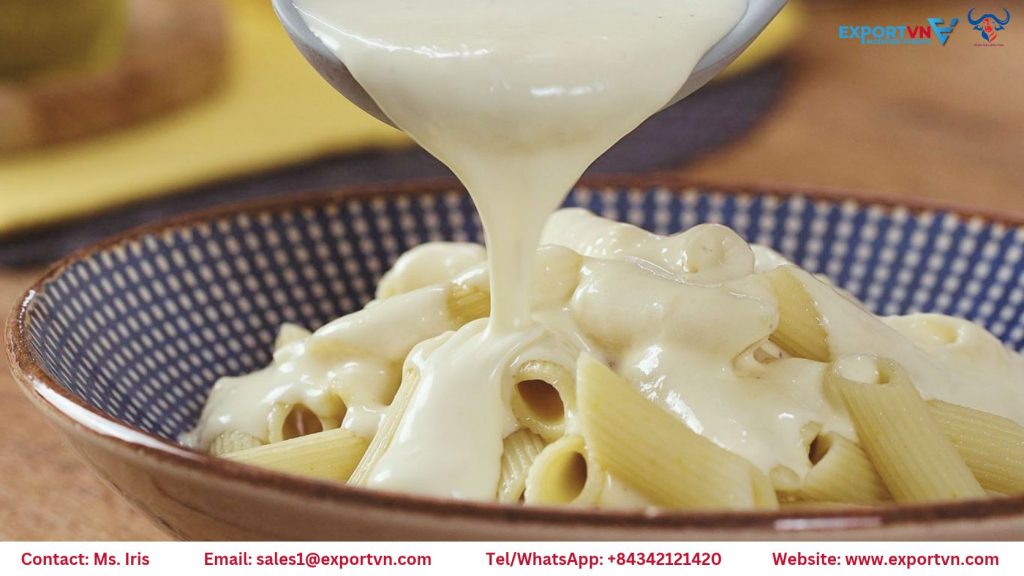
E1414 – Acetylated Distarch Phosphate
E1414 Modified Tapioca Starch combines phosphate cross-linking with acetylation to provide effective thickening and improved processing stability.
Key Functional Benefits
- Effective viscosity development.
- Smooth and consistent texture.
- Improved processing resistance.
- Enhanced water retention.
- Reduced risk of texture changes during storage.
Recommended Sauce Applications
E1414 is suitable for evaluation in tomato ketchup, chili sauce, oyster sauce, gravies, barbecue sauce and savory cooking sauces.
It provides an alternative for manufacturers seeking a balance between thickening performance, texture and processing tolerance.
E1450 – Starch Sodium Octenyl Succinate
E1450 Modified Tapioca Starch, commonly known as OSA starch, is primarily used for its emulsifying functionality.
Unlike conventional thickening starches, E1450 contains both hydrophilic and hydrophobic groups. These properties allow it to help stabilize oil droplets within water-based food systems.
Key Functional Benefits
- Improved oil-in-water emulsion stability.
- Reduced risk of oil separation.
- More uniform distribution of oil droplets.
- Enhanced creaminess and mouthfeel.
- Supports egg-reduced and egg-free formulations.
Recommended Sauce Applications
E1450 is particularly useful in mayonnaise, egg-free mayonnaise, salad dressing, creamy dips and other emulsified sauces.
For low-fat mayonnaise, E1450 can be combined with E1422 or E1442 to support both emulsification and texture development.
While E1450 mainly supports emulsion stability, E1422 and E1442 primarily provide viscosity and body.
Learn more about the role of emulsified starch in low-fat mayonnaise, dressings and sauces.
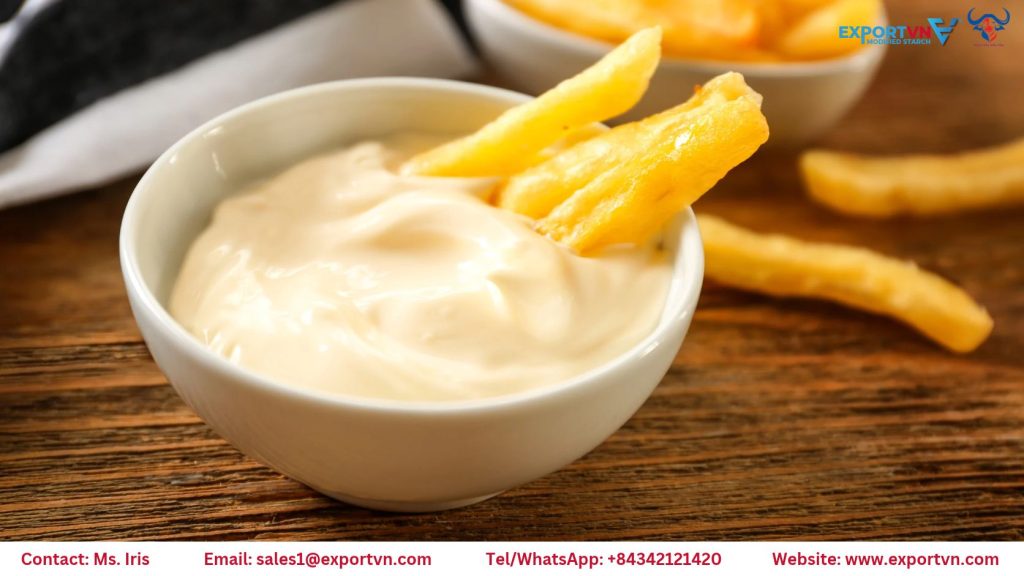
Pregelatinized Modified Tapioca Starch for Cold-Process Sauces
Pregelatinized modified tapioca starch, also known as instant or cold-swelling starch, develops viscosity without requiring conventional cooking.
For manufacturers exploring how to improve sauce texture without heating, Pregelatinized E1442 and suitable pregelatinized E1422 grades offer practical formulation solutions.
Key Functional Benefits
- Instant thickening in cold water.
- Rapid viscosity development.
- No additional cooking required for starch gelatinization.
- Smooth and uniform texture when properly dispersed.
- Potential reduction in processing time and energy consumption.
Recommended Sauce Applications
Pregelatinized modified starch is suitable for cold-process mayonnaise, instant sauces, salad dressings, dipping sauces and cold-prepared creamy sauces.
Comparison of Modified Tapioca Starches for Sauce Applications
| Modified Starch | Main Function | Recommended Applications |
|---|---|---|
| E1422 | Thickening, gloss and processing stability | Ketchup, chili sauce, BBQ sauce |
| E1442 | Creaminess, water retention and freeze-thaw stability | Cheese sauce, cream sauce, frozen sauces |
| E1414 | Thickening and viscosity stability | Oyster sauce, ketchup, cooking sauces |
| E1450 | Emulsification and oil-water stability | Mayonnaise, egg-free mayonnaise, dressings |
| Pregelatinized E1422 | Instant thickening and consistency | Cold-process sauces |
| Pregelatinized E1442 | Instant thickening and creamy mouthfeel | Cold-process mayonnaise, creamy dressings |
The optimal starch depends not only on its E-number but also on its commercial grade, modification level and intended application.
4. How to Use Modified Tapioca Starch in Sauce Formulations
Understanding how to improve sauce texture requires careful consideration of starch selection, dosage, processing methods and ingredient interactions.
Even a high-performance modified starch may deliver undesirable results if it is used incorrectly.
How to Choose the Right Modified Starch for Your Sauce
Before selecting a modified starch, food manufacturers should identify their primary formulation objectives.
| Formulation Objective | Recommended Starch for Evaluation |
|---|---|
| High viscosity and glossy appearance | E1422 |
| Smooth and creamy mouthfeel | E1442 |
| Heat and acid resistance | Suitable E1422, E1442 or E1414 grades |
| Freeze-thaw stability | E1442 |
| Oil-in-water emulsion stability | E1450 |
| Improved body in low-fat sauces | E1422, E1442 |
| Instant cold-water thickening | Pregelatinized E1422 or E1442 |
In mayonnaise production, starch selection should also consider egg content, oil concentration and the manufacturing process.
Traditional mayonnaise containing eggs may require starch primarily for texture adjustment. Egg-free mayonnaise may require additional emulsification support. Meanwhile, low-fat mayonnaise often requires greater water retention and viscosity development.
Recommended Modified Starch Dosage for Different Sauce Applications
Selecting the appropriate dosage is another important consideration when determining how to improve sauce texture and mouthfeel.
Using too little starch may result in insufficient viscosity. On the other hand, excessive dosage may create an overly thick, sticky or gummy texture.
The following table provides suggested starting ranges for formulation trials.
| Sauce Application | Recommended Modified Starch | Suggested Trial Dosage |
|---|---|---|
| Tomato Ketchup | E1422, E1414 | 2–5% |
| Chili Sauce | E1422, E1442 | 2–5% |
| Sweet Chili Sauce | E1422, E1414 | 1–4% |
| BBQ Sauce | E1422, E1414 | 2–4% |
| Oyster Sauce | E1422, E1442 | 2–5% |
| Mayonnaise | E1422, E1442 | 2–5% |
| Low-Fat Mayonnaise | E1422, E1442 | 4–8% |
| Salad Dressing | E1422, E1442 | 1–4% |
| Cheese Sauce | E1442, E1422 | 2–5% |
| Cream Sauce | E1442, E1422 | 2–5% |
| Frozen Sauce | E1442 | 2–5% |
| Gravies | E1422, E1414 | 2–5% |
Note: The suggested dosage is based on the total formulation weight and serves as an initial guideline for product development. The optimal dosage depends on the starch grade, ingredient composition, processing conditions and desired final texture. E1450 dosage should be evaluated separately based on oil content and emulsification requirements.
For additional formulation references, manufacturers can explore our tomato sauce recipe and low-fat mayonnaise recipe.
Using Modified Starch in Hot-Process and Cold-Process Sauces
The manufacturing process plays an important role in starch hydration, gelatinization and final texture development.
Hot-Process Sauce Manufacturing
Cook-up modified starches require sufficient heat and water to develop their functional properties.
A typical production process includes:
- Disperse the modified starch in cold water or blend it with compatible dry ingredients.
- Add the starch mixture to the sauce formulation under controlled agitation.
- Heat the mixture to the recommended gelatinization temperature.
- Maintain suitable processing conditions until the required viscosity develops.
- Follow the validated filling and cooling procedure.
Hot-process modified starches are commonly used in ketchup, chili sauce, cheese sauce, oyster sauce and gravies.
For acidic formulations, manufacturers should optimize the timing of acid addition to minimize viscosity breakdown while maintaining validated food safety requirements.
Cold-Process Sauce Manufacturing
Pregelatinized modified starches are suitable for formulations that do not require heating for starch gelatinization.
A typical manufacturing process includes:
- Dry-blend the starch with compatible powdered ingredients where appropriate.
- Gradually disperse the starch into the aqueous phase.
- Mix under controlled agitation to ensure uniform hydration.
- Allow sufficient time for viscosity development.
- Incorporate the remaining ingredients and adjust the final texture.
This method is particularly suitable for cold-process mayonnaise, salad dressings and instant sauces.
Best Practices for Achieving Optimal Sauce Texture and Mouthfeel
Food manufacturers looking for practical solutions on how to improve sauce texture should consider the following recommendations:
- Ensure proper starch dispersion to prevent lump formation.
- Select suitable starch grades for acidic formulations.
- Control processing temperature, cooking time and shear intensity.
- Avoid excessive starch dosage.
- Evaluate viscosity after processing, cooling and storage.
- Balance thickness, creaminess and pourability.
- Conduct sensory evaluations and storage stability tests.
- Validate starch performance under actual industrial production conditions.
Manufacturers should also review applicable food additive and labeling requirements in their target markets. The Codex General Standard for Food Additives (GSFA) provides an international reference for food additive provisions.
5. Modified Tapioca Starch Solutions for Sauce Manufacturers – EXPORTVN
Customized Modified Starch Solutions for Different Sauce Applications
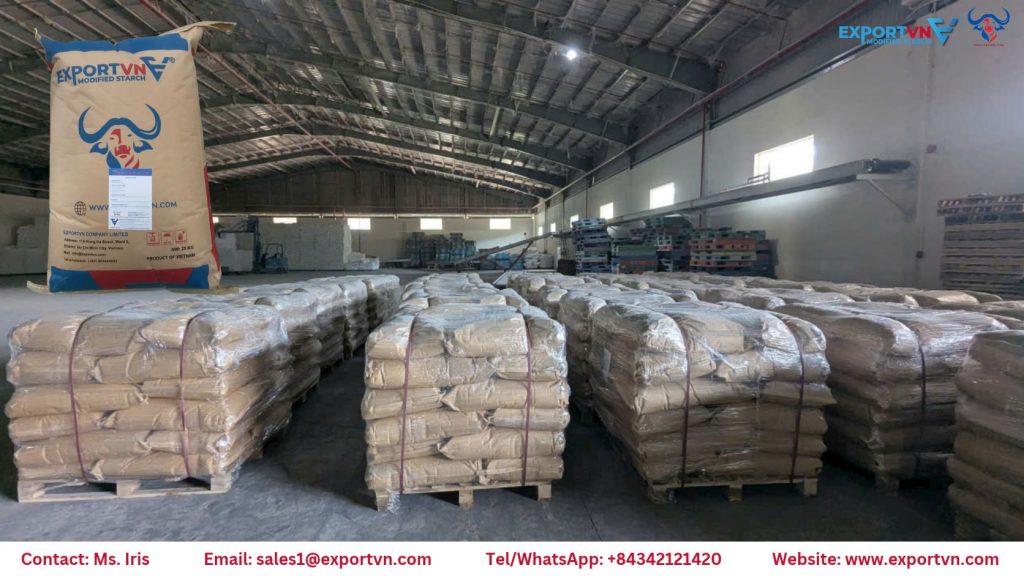
Every sauce formulation has unique processing and texture requirements. Therefore, selecting the appropriate modified tapioca starch is essential for achieving consistent product quality.
EXPORTVN CO., LTD is a Vietnamese manufacturer and exporter of food-grade modified tapioca starch, providing functional ingredient solutions for international food manufacturers and distributors.
Our modified starch portfolio includes E1422, E1442, E1414, E1450 and pregelatinized modified starches for various sauce manufacturing requirements.
Our solutions are designed to support:
- Customized viscosity and texture profiles.
- Smooth and creamy mouthfeel.
- Improved heat, acid and shear stability.
- Enhanced water holding capacity.
- Reduced water separation.
- Improved emulsion stability.
- Freeze-thaw stability.
- Hot-process and cold-process applications.
- Cost-effective formulation development.
Why Choose EXPORTVN as Your Modified Tapioca Starch Supplier?
As a modified tapioca starch manufacturer in Vietnam, EXPORTVN focuses on helping customers select functional starch solutions suited to their specific production requirements.
We support international customers with:
- A wide range of food-grade modified tapioca starches.
- Application-specific product recommendations.
- Technical consultation and formulation support.
- Samples for R&D and industrial trials.
- Technical Data Sheets and Certificates of Analysis.
- ISO 22000, HACCP, Halal and Kosher certification documentation, subject to the selected product.
- Bulk supply and international export support.
Find the Right Solution to Improve Your Sauce Texture
Understanding how to improve sauce texture and mouthfeel goes beyond simply increasing viscosity.
The right modified tapioca starch can help manufacturers develop smoother, creamier and more stable sauces while maintaining consistent quality throughout processing and storage.
Whether you are developing a new sauce formulation, improving an existing product or searching for a cost-effective alternative to your current starch ingredient, EXPORTVN is ready to support your product development.
Are you looking for solutions on how to improve sauce texture, creaminess, mouthfeel and processing stability?
Contact EXPORTVN today for customized product recommendations, technical specifications, competitive quotations and samples for your next formulation trial.
EXPORTVN CO., LTD – Your Trusted Modified Tapioca Starch Supplier from Vietnam
Email: sales1@exportvn.com
WhatsApp: +84342121420
Website: https://exportvn.com/us/
