
Properties of starch
WHICH STARCH IS BEST FOR BUBBLE TEA?
Feb
The global Bubble Tea industry is experiencing explosive growth. Consequently, determining Which Starch is Best for Bubble Tea is crucial for consumers seeking the perfect mouthfeel in every sip. In fact, at the heart of this beverage revolution lies the Tapioca Pearl (commonly known as Boba). It is the defining element that dictates the quality of the drink. However, producing a pearl that remains consistently soft in cold beverages is complex. Manufacturers face a significant technical challenge to maintain chewiness and translucency.
The difference between a premium pearl and one that becomes hard or mushy lies entirely in the raw material selection. As a specialized manufacturer, choosing the right starch is the most critical decision to ensure your Boba stands out. This guide analyzes the specific properties of Native and Modified Starches, helping you master the texture of your Tapioca Pearl and select the ideal formulation for your production line.
The Foundation: Native Starch for Traditional Boba
Historically, producers made traditional Tapioca Pearls exclusively using starch derived from the cassava root. For artisanal shops producing fresh batches daily, high-quality Native Tapioca Starch is often the preferred Starch for Bubble Tea. Specifically, it provides a clean, neutral flavor profile that absorbs brown sugar well and offers a classic soft texture that purists adore.
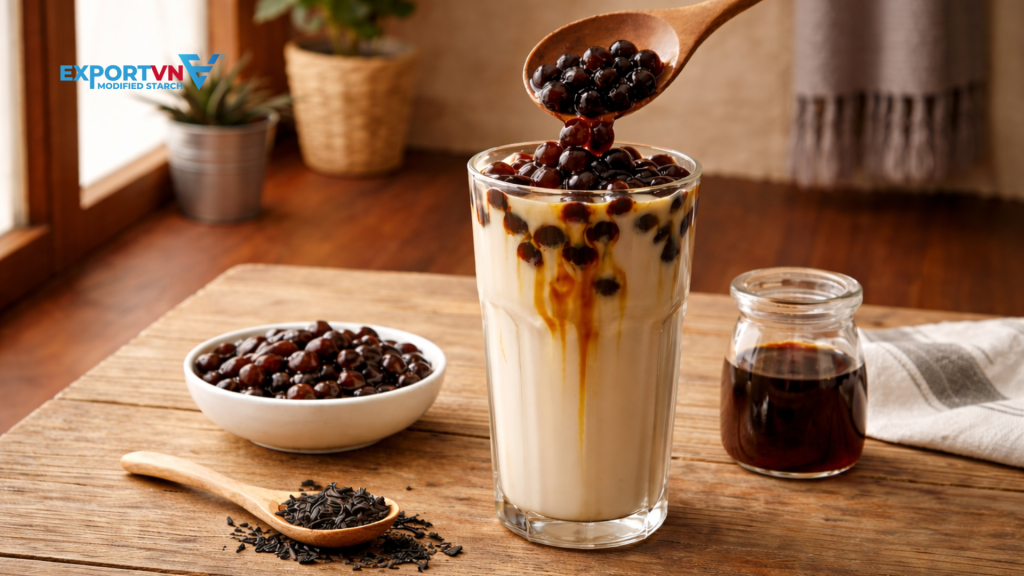
However, from an industrial manufacturing perspective, relying solely on native starch presents a significant hurdle: retrogradation. This is the process where starch molecules recrystallize after cooling. When you place a Tapioca Pearl made purely from native starch into an iced Bubble Tea, the cold temperature accelerates this recrystallization, causing the pearl to harden and turn opaque within hours. Therefore, while native starch is the foundation, it requires enhancement for modern supply chains that demand extended shelf life and cold stability.
The Solution: Modified Starch for Premium Pearls
To conquer the global market, where Boba must survive international shipping, high-temperature cooking, and icy serving conditions, manufacturers must utilize Modified Tapioca Starch. Functionally, these starches reinforce the granule structure and lock in moisture. Below are the specific modified starches essential for high-quality Bubble Tea manufacturing:
Acetylated Starch (E1420) – Enhancing Elasticity
Specifically, for manufacturers aiming to create a pearl with superior “bounce” and elasticity, Acetylated Starch (E1420) is the key ingredient. This modification significantly lowers the gelatinization temperature, preventing the Boba from becoming mushy during cooking. Moreover, E1420 contributes significantly to the visual appeal of the product, ensuring high clarity and transparency, which is vital for the aesthetics of modern crystal boba.
Distarch Phosphate (E1412) – Building Structure and Heat Resistance
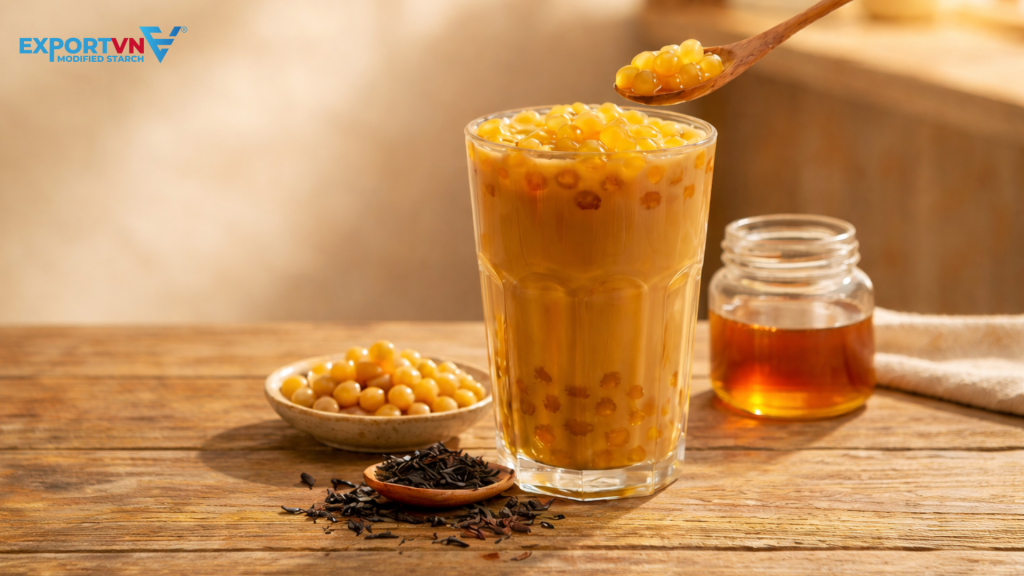
Furthermore, when a customer bites into a premium Tapioca Pearl, they expect a satisfying resistance – a firm structure that doesn’t collapse immediately. You can achieve this integrity using Distarch Phosphate E1412. As a cross-linked starch, E1412 reinforces the molecular bonds, allowing the granules to withstand the high shear and heat of industrial boiling processes without disintegrating. As a result, it ensures the pearl maintains a round shape and a clean, short bite.
Hydroxypropyl Distarch Phosphate (E1442) – The Freeze-Thaw King
Undoubtedly, perhaps the most critical innovation for the Bubble Tea industry is E1442. This starch is the “Gold Standard” for supply chains involving freezing or cold storage, such as instant Tapioca Pearl kits. Essentially, E1442 prevents retrogradation at low temperatures, acting as a shield against hardening.
Therefore, manufacturers must understand the distinct applications of different starches. For instance, while you might read about Modified Tapioca Starch E1422 being excellent for fruit fillings and sauces due to its shear stability, E1442 is far superior for the cold stability required in dairy and dessert applications like Bubble Tea. Understanding the difference between E1422 and E1442 is crucial for formulating a pearl that stays soft even after being frozen and reheated in a microwave.
The Perfect Blend: Premix Starch for Bubble Tea Solutions
In reality, most successful Bubble Tea factories do not rely on a single type of starch. Instead, they utilize a proprietary blend – a “premix” – that combines the body of Native Starch with the functional benefits of E1412 and E1442. For example, a balanced formula might include Native Starch for cost efficiency, E1412 for structural integrity, and E1442 to ensure the Boba remains soft in iced drinks.
At EXPORTVN, we supply specific solutions tailored for this industry, including specialized Bubble Tea Pearls / Boba Balls Applications. Whether you need ready-to-cook pearls or the raw modified starch components to mix your own dough, we have the precise formulations to meet your production needs.
Troubleshooting: Why Your Pearls Might Fail
Even with advanced machinery, using the wrong starch blend can lead to product failure. Here is a technical breakdown of common issues:
– Disintegration: If your pearls dissolve or turn into soup during boiling, your starch lacks heat resistance. You need to increase the ratio of Cross-linked Starch (E1412).
– Hardening in Cold Drinks: If the pearls become hard pebbles after 30 minutes in iced tea, rapid retrogradation is the cause. You must introduce or increase Hydroxypropyl Distarch Phosphate (E1442) to stabilize the texture.
– Stickiness: If the pearls clump together excessively, the surface is too gelatinous. Adjusting the native starch ratio or checking your coating powder is necessary.
Why Choose EXPORTVN as Your Partner?
Vietnam is currently one of the top 5 leading countries exporting modified cassava starch globally, and EXPORTVN is at the forefront of this industry.
We understand that texture is the soul of Bubble Tea. We do not just sell starch; we provide technical solutions. Furthermore, we can customize the ratios of E1412 and E1442 in our supplies to match the specific chewiness level preferred by your target market – whether it’s the softer texture for the Japanese market or the chewier bite for the US market.
With a track record of exporting to over 30 countries, we ensure your supply chain is stable and your product quality is consistent.
Ready to Upgrade Your Tapioca Pearls?
So, don’t let your Boba get hard in cold drinks or break apart during cooking. Improve your Bubble Tea quality with EXPORTVN’s specialized Modified Starch today.
Contact us for a free sample and technical consultation:
Ray Le (Mr.)
Overseas Sales Executive
EXPORTVN CO., LTD
Office: No. 41, T2 Street, Manhattan Villa Area, Vinhomes Grand Park, Long Binh Ward, Ho Chi Minh City, Vietnam.
Whatsapp/Mob: +84 384 653 212
Email: sales3@exportvn.com
Web: exportvn.com | modifiedfoodstarch.com
