


Common types of modified starch, Market Update, Properties of starch, Similar Starches
Oxidized Starch E1404 Manufacturer in Vietnam
Sep
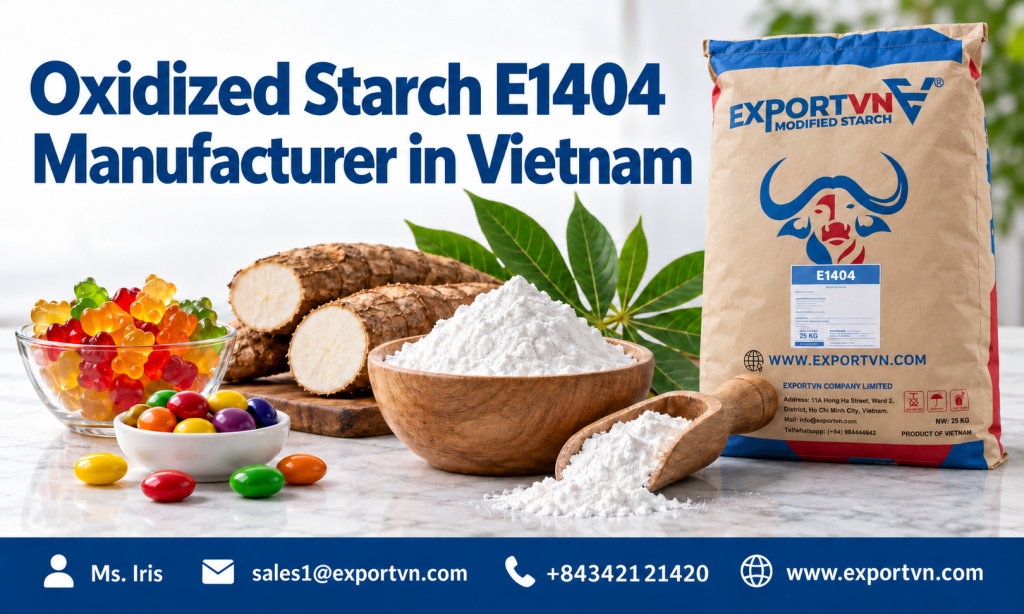
Looking for an Oxidized Starch E1404 Manufacturer in Vietnam? EXPORTVN supplies OXIFLO for buyers seeking modified tapioca starch with film-forming properties and surface-finishing potential. For food manufacturers, choosing the right starch involves more than comparing prices: specifications, processing conditions and finished-product performance all matter. This guide explains what E1404 is, highlights the characteristics documented for OXIFLO, and outlines practical considerations for confectionery and coating trials. You will also find technical specifications, packaging options and the information needed to request a suitable sample or export quotation. Start with your application requirements, then assess the grade against your production process.
1. What Is Oxidized Starch E1404?
Understanding Oxidized Starch and INS 1404
Oxidized starch is starch modified through controlled oxidation. This treatment changes its molecular structure and functional behavior. The FAO/JECFA additive database identifies oxidized starch as INS 1404.
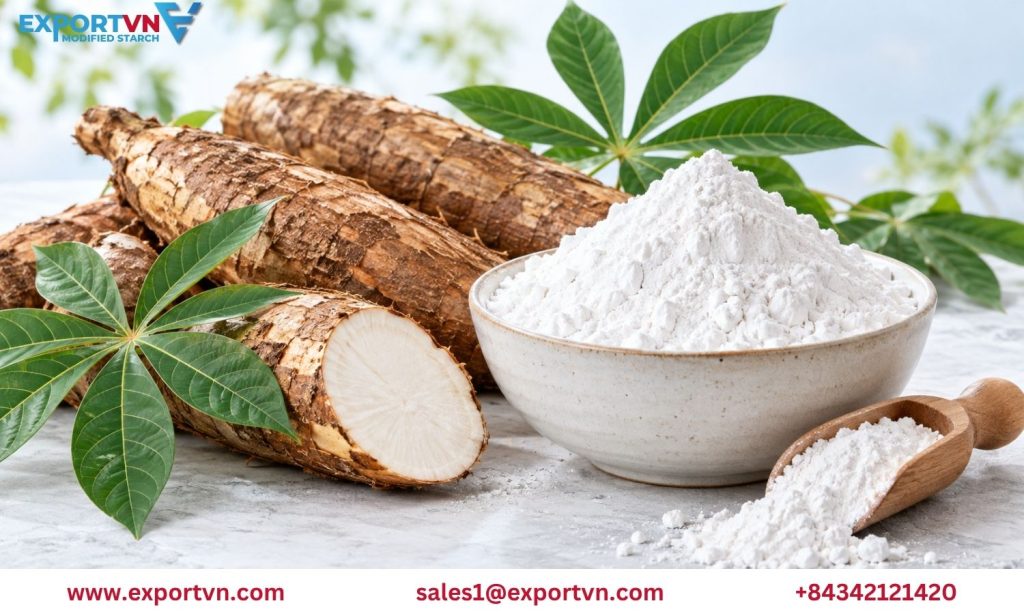
EXPORTVN’s E1404 oxidized tapioca starch belongs to its tapioca-based ingredient range. OXIFLO is the commercial grade covered by the technical specifications below. Its TDS highlights thin-film formation and surface gloss, with gummies among the listed applications.
Tapioca-Based E1404 vs. Native Tapioca Starch
Both ingredients can originate from cassava. However, their processing and selection criteria differ.
| Selection point | Native tapioca starch | OXIFLO E1404 |
|---|---|---|
| Processing | Extracted starch without an oxidation modification step | Modified through oxidation |
| Functional assessment | Evaluate native thickening and texture behavior | Evaluate film formation, surface finish and viscosity |
| Purchasing specification | Depends on the native grade | Minimum 300 BU using the specified 6% Brabender method |
Compare samples under identical cooking and measurement conditions. A viscosity value alone does not establish which starch will perform better in your recipe.
2. Functional Benefits of OXIFLO Oxidized Tapioca Starch
Thin-Film Formation and Surface Gloss
OXIFLO’s TDS identifies good thin-film-forming ability and the capacity to create surface gloss. These characteristics make film coverage and appearance useful starting points for application trials.
For example, a coating trial can assess whether the cooked starch system spreads evenly, dries consistently and gives the desired finish. Evaluate the result after storage as well as immediately after production.

Viscosity Control During Processing
The specified viscosity is ≥300 BU, measured by the Brabender method at 6% concentration. This is a minimum specification under a defined test method, rather than a guaranteed viscosity in every food formulation.
Consequently, manufacturers should check flow behavior at their actual solids content, cooking temperature and mixing conditions. This helps establish a workable balance between application consistency and coating thickness.
Moisture-Related Performance
The TDS also lists reduced water absorption and oxidation among OXIFLO’s characteristics. Treat these as properties to evaluate in the finished formulation. The document does not quantify the reduction or establish a finished-food shelf-life extension.
For development work, compare treated and control samples under the same packaging and storage conditions. Track changes in appearance, surface condition and texture over time.
3. Food Applications – Oxidized Starch E1404 Manufacturer in Vietnam
Gummies and Confectionery
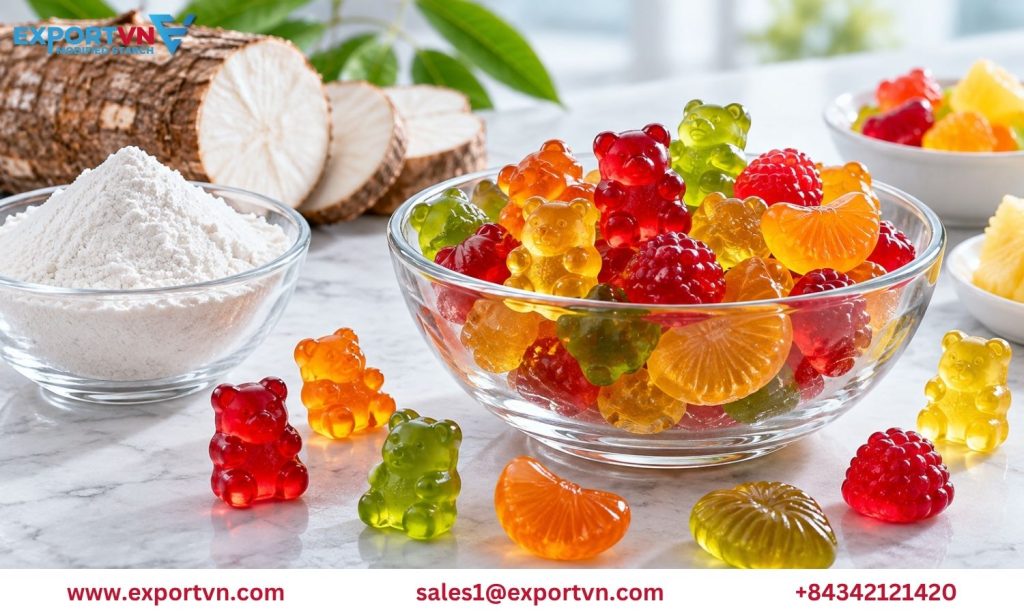
Gummies are explicitly listed in the OXIFLO TDS. For this application, first define the intended role of the starch: contribution to the formulation, a surface treatment, or another process-specific function.
Then evaluate it alongside the existing gelling system and other ingredients. Useful trial observations include chew, surface tack, appearance and consistency after storage. The appropriate dosage and cooking procedure should be established through trials rather than assumed from the E-number.
Food Coatings and Surface Finishing
OXIFLO’s documented film-forming and gloss characteristics support its evaluation in coating development. A practical trial should examine:
- Dispersion and cooking behavior.
- Coating pickup and uniformity.
- Drying time and surface finish.
- Tackiness and texture during storage.
Keep other recipe variables constant during initial comparisons. Afterwards, adjust the starch level or processing conditions to address the specific result you want to improve.
Assessing Other Food Applications
For noodles, bakery products or other foods, share your process with EXPORTVN before selecting a grade. The OXIFLO TDS does not provide dedicated performance data for these applications. Discussing temperature, pH, mixing intensity and target texture helps determine whether OXIFLO is a suitable trial candidate.
4. OXIFLO E1404 Specifications, Quality and Packaging
Technical Specifications Oxidized Starch E1404 Manufacturer in Vietnam
The following values are specification limits from the OXIFLO TDS, not individual batch results.
| Parameter | Specification |
|---|---|
| Starch content | ≥85.0% |
| Moisture | ≤14.0% |
| Viscosity, Brabender method at 6% | ≥300 BU |
| Fineness, #100 | ≥99.5% |
| Slurry residue | ≤0.03% |
| Whiteness | ≥90.5% |
| Ash | ≤0.3% |
| Fiber | ≤0.05% |
| pH | 5.0–7.0 |
| SO₂ | ≤10 ppm |
| Lead (Pb) | ≤0.1 ppm |
| Cadmium (Cd) | ≤0.1 ppm |
Use the relevant batch COA when reviewing shipment results against agreed purchasing requirements.
Microbiological Specifications and Documentation
The TDS includes these microbiological limits:
| Parameter | Limit, CFU/g |
|---|---|
| Mesophilic aerobic bacteria | ≤10⁴ |
| Coliforms | ≤10² |
| Staphylococcus aureus | ≤10³ |
| Clostridium perfringens | ≤10² |
| Bacillus cereus | ≤10³ |
| Yeast and moulds | ≤10³ |
| Escherichia coli | ≤10² |
Ask for the current TDS and relevant COA during supplier qualification. If your approval process requires SDS, allergen, Non-GMO, Halal or Kosher documentation, specify those requirements so the applicable documents can be confirmed.
Packaging, Shelf Life and Storage
OXIFLO’s listed packaging options are:
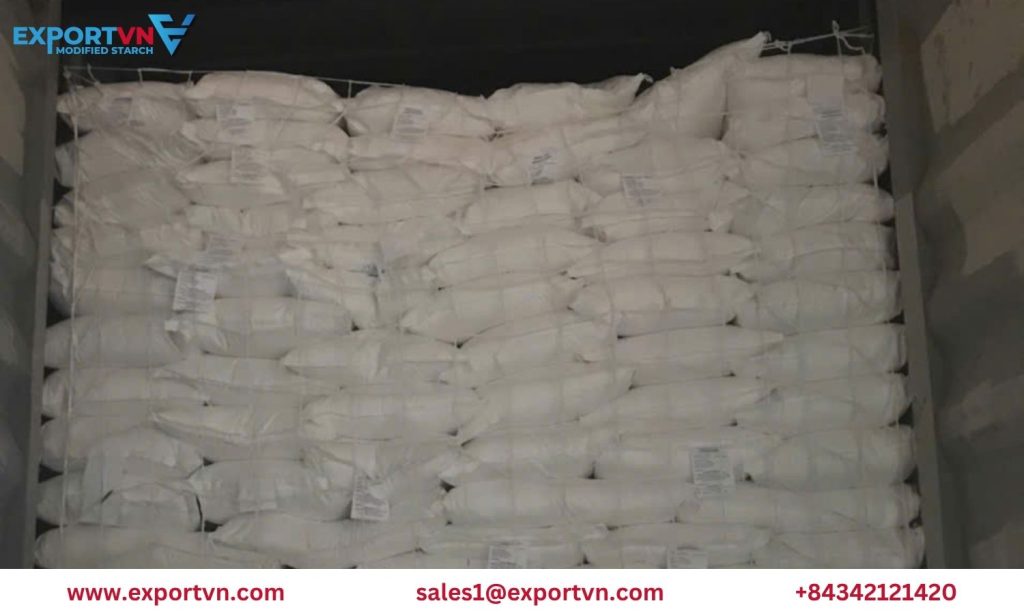
- Paper bags: 25 kg.
- PP bags: 25 kg or 50 kg.
- Jumbo bags: 850 kg.
The stated shelf life is two years from manufacture. Store the product in a clean, dry, cool location, away from water, humidity, high temperatures, odorous substances and toxic materials. Confirm pallet requirements when arranging shipment.
5. Sourcing Oxidized Starch E1404 from Vietnam
Discuss Your Application with EXPORTVN
EXPORTVN CO., LTD provides native and modified starch products for business customers. A useful sourcing discussion begins with the food you manufacture, the problem you want to solve and your acceptance criteria.
Provide your current starch specification where possible. This makes the comparison more practical and helps focus sample evaluation on measurable outcomes.
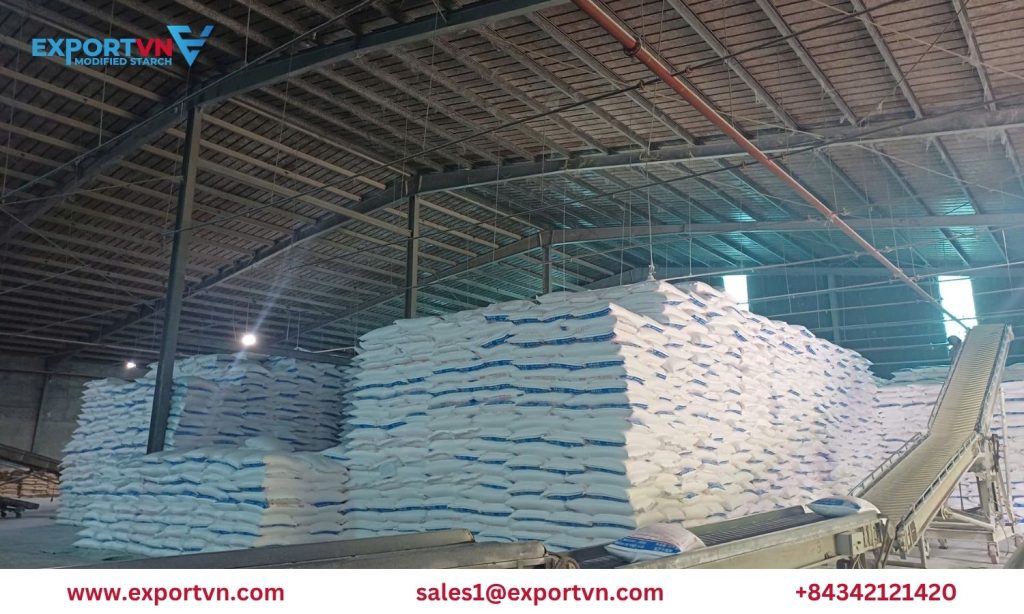
Confirm MOQ, Lead Time and Export Requirements
Request the current minimum order quantity, production lead time and packing availability with your quotation. Also state the destination port, preferred delivery term and any required export documents. These details allow the offer to reflect your shipment requirements.
Request TDS, COA, Samples and a Quotation
Ready to evaluate OXIFLO? Contact EXPORTVN for E1404 technical information and a quotation. Include your application, estimated order volume, packaging preference and destination. For sample requests, describe your trial process and target performance so the discussion starts with your production needs.
Email: sales1@exportvn.com
WhatsApp: +84 342 121 420
Website: EXPORTVN’s official website
