


Common types of modified starch, Properties of starch
Modified Food Starch for Custard Sauce | EXPORTVN EMS
Sep
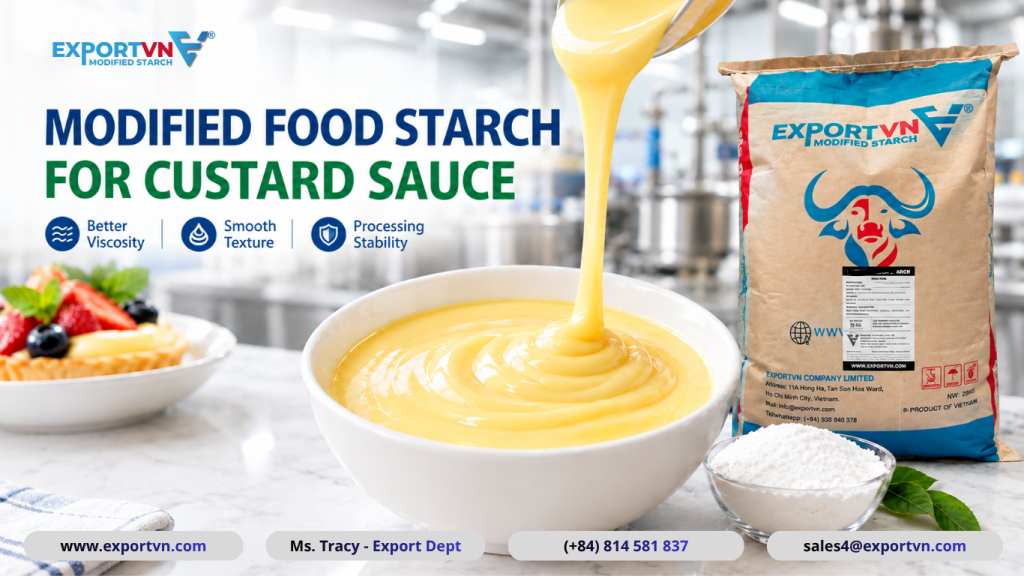
Custard sauce requires the right balance of viscosity, smoothness, and stability. Modified food starch for custard sauce can help food manufacturers control texture and improve processing performance.
For industrial production, starch selection should match the complete formulation and processing conditions. Milk, sugar, egg, fat, heating, shear, cooling, and storage can all affect the final sauce.
EXPORTVN EMS supplies modified food starch solutions for international food manufacturers. Our approach focuses on the actual application rather than selecting a starch based only on its E-number.
Why Use Modified Food Starch in Custard Sauce?
Custard sauce is a complex food system. It can contain dairy ingredients, sugar, egg, fat, flavors, and other functional ingredients.
Therefore, the starch must perform well within the complete formulation. A suitable modified starch can help manufacturers achieve the desired viscosity and texture while maintaining more consistent processing results.
The Role of Modified Starch in Custard Sauce
The main function of starch in custard sauce is thickening. However, industrial applications require more than simple thickening.
Moreover, a suitable modified starch can help control the viscosity of the sauce during heating and after cooling. It can also contribute to a smooth and consistent texture.
In addition, starch selection can affect the final mouthfeel. The right starch system should provide the desired body without making the sauce excessively heavy or pasty.
Modified starch can also support processing consistency. During industrial production, the sauce may experience heating, mixing, pumping, and cooling. Each step can influence starch performance.
For this reason, manufacturers should evaluate the following properties:
- Viscosity and thickening performance
- Smooth texture and mouthfeel
- Processing performance
- Texture consistency after cooling
- Storage stability
- Compatibility with the complete formulation
The final result depends on the starch grade, dosage, formulation, and processing conditions. Therefore, laboratory testing remains important before commercial production.
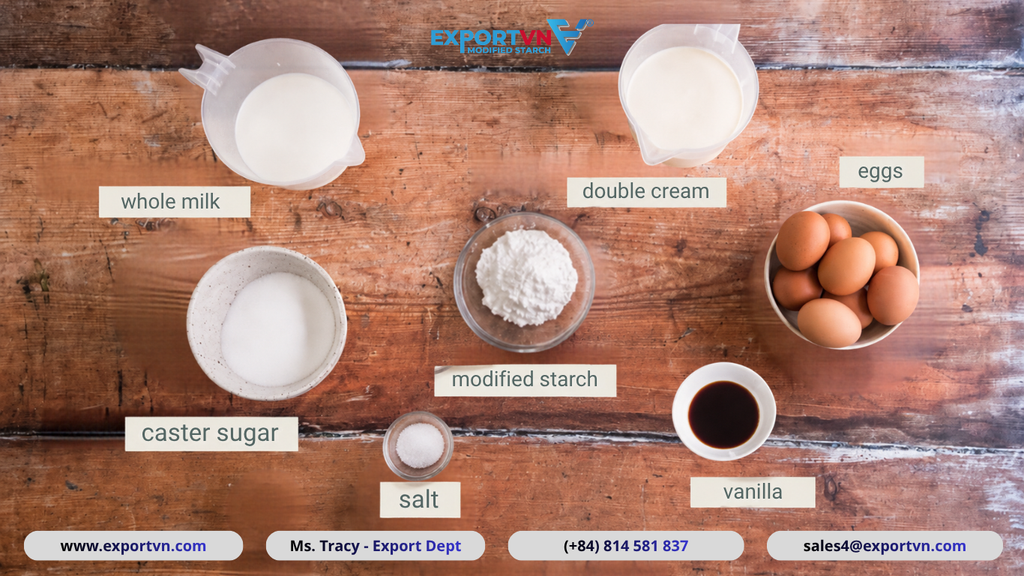
Basic Custard Sauce Formula with Modified Starch
However, a basic custard sauce formulation can include several key ingredients. The exact ratio should be adjusted according to the target product and processing method.
| Ingredient | Main Function |
|---|---|
| Milk or water | Liquid base |
| Sugar | Sweetness and solids |
| Egg yolk or egg component | Body, color, and flavor |
| Modified food starch | Thickening and texture control |
| Cream or fat | Richness and mouthfeel |
| Flavor | Product profile |
| Salt | Flavor balance |
For product development, the modified starch should first be properly dispersed to reduce the risk of lump formation. The mixture can then be heated under controlled conditions.
As the temperature increases, the starch hydrates and develops viscosity. Mixing should remain consistent throughout the heating stage.
After cooking, the custard sauce can be cooled and evaluated again. This step is important because the final texture may change during cooling and storage.
A practical evaluation should compare:
- Viscosity before and after cooling
- Sauce appearance
- Smoothness
- Mouthfeel
- Water separation
- Texture after storage
This formulation is a starting point for product development. The optimum starch level depends on the selected starch, target viscosity, ingredients, processing conditions, and final application.
Which Modified Starch Is Suitable for Custard Sauce?
There is no single modified starch that is ideal for every custard sauce. Different starch sources can provide different texture and viscosity profiles.
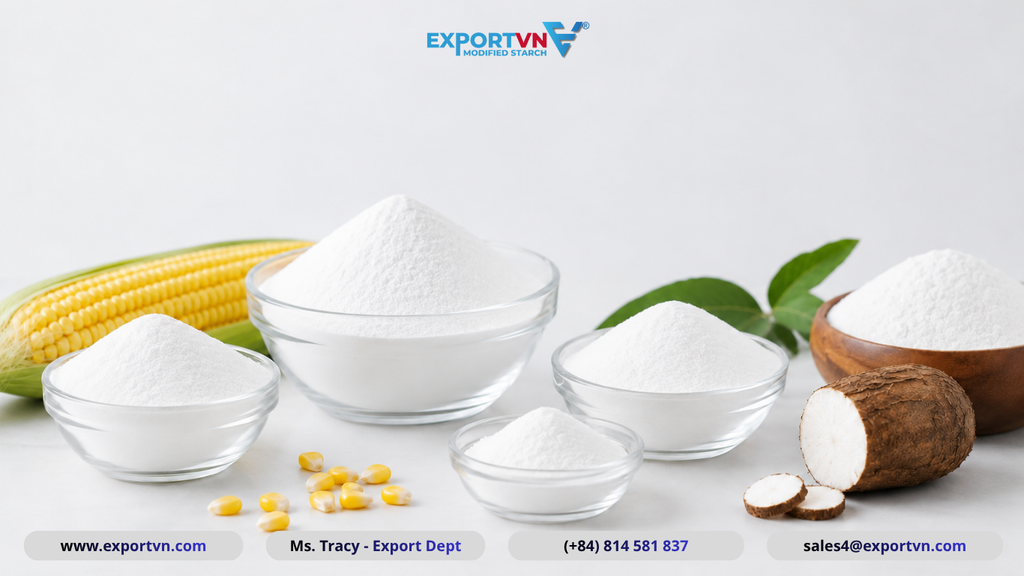
Two options that manufacturers may consider are modified tapioca starch and modified waxy corn starch.
The appropriate choice depends on the desired texture, formulation, processing conditions, and storage requirements.
Modified Tapioca Starch
Modified tapioca starch is widely considered for food applications where smooth texture and controlled thickening are important.
In custard sauce, a suitable modified tapioca starch can help develop the desired body while maintaining a smooth mouthfeel.
It can be considered for applications such as:
- Custard sauce
- Dessert toppings
- Custard fillings
- Bakery fillings
- Other thickened food systems
However, performance depends on the specific modified starch grade. Different modification methods can provide different functional properties.
Therefore, manufacturers should define their target viscosity and processing conditions before selecting the final grade.
EXPORTVN EMS can provide modified tapioca starch options for customers who are developing or optimizing custard-based products.
Modified Waxy Corn Starch
Modified waxy corn starch is another option for manufacturers seeking specific viscosity and texture characteristics.
Compared with tapioca-based systems, waxy corn starch can provide a different viscosity profile and functional behavior. This difference can be useful when a formulation requires a particular body or texture.
Modified waxy corn starch may be considered when the manufacturer needs to evaluate:
- Viscosity development
- Texture profile
- Processing performance
- Stability during cooling
- Storage behavior
The choice between modified tapioca starch and modified waxy corn starch should not be based on starch source alone.
Instead, manufacturers should compare both options under the same formulation and processing conditions. This approach provides a more reliable basis for product selection.
In practice, EXPORTVN EMS can help customers evaluate the two starch options according to their specific application.
How EXPORTVN EMS Supports Custard Sauce Manufacturers
Choosing a starch for industrial production involves more than purchasing an ingredient. The starch must work with the customer’s formulation, equipment, process, and commercial requirements.
EXPORTVN EMS therefore focuses on application-based consultation for international B2B customers.
Application-Based Starch Recommendation
Before recommending a suitable starch, EXPORTVN EMS can review the customer’s technical requirements.
Useful information includes:
- Product application
- Target viscosity
- Current starch or benchmark product
- Formulation requirements
- Heating temperature and time
- Mixing and shear conditions
- Cooling process
- Storage conditions
- Required certifications
- Estimated purchase volume
This information helps identify whether modified tapioca starch, modified waxy corn starch, or another starch solution should be evaluated.
The recommended product should then be tested in the customer’s actual formulation. This process helps reduce unnecessary trial and error during product development.
Most importantly, the recommendation should focus on the customer’s final product requirements rather than simply matching an E-number.
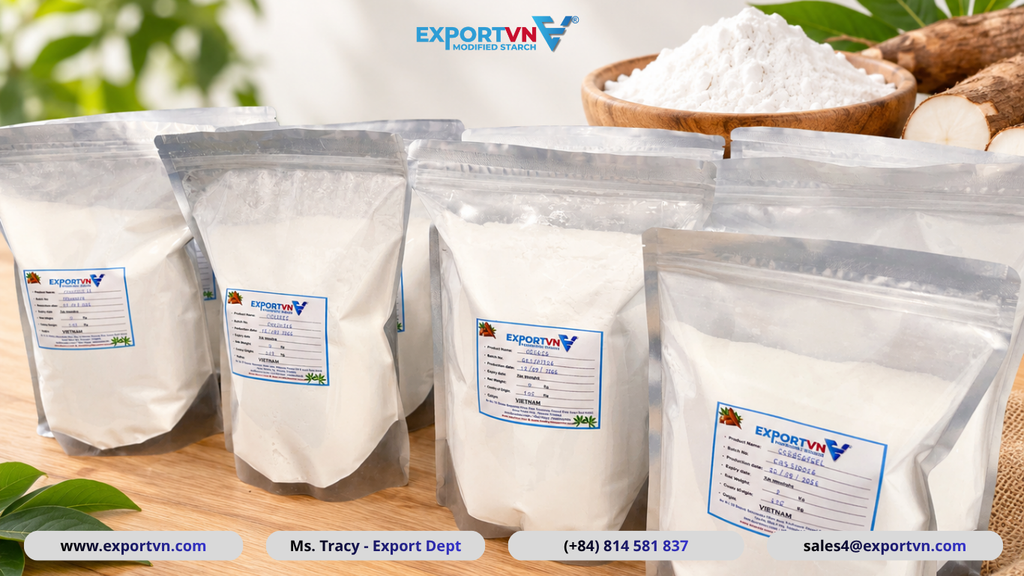
Samples, Technical Documents and Export Supply
EXPORTVN EMS supports international buyers through the product evaluation and export process.
Depending on the selected product and destination, customers may request technical and quality documents such as:
- Technical Data Sheet (TDS)
- Certificate of Analysis (COA)
- Material Safety Data Sheet (MSDS)
- Halal certificate
- Kosher certificate
- HACCP documentation
- ISO 22000 documentation
- Other required export documents
Product samples can also be arranged for application testing. After evaluation, customers can provide feedback on viscosity, texture, processing behavior, and storage performance.
Based on the test results, EXPORTVN EMS can continue supporting the customer toward commercial supply.
This application-based approach helps connect product selection, technical requirements, sample testing, and international supply in one process.
Conclusion
Modified food starch for custard sauce can play an important role in controlling viscosity, texture, mouthfeel, and processing performance.
Both modified tapioca starch and modified waxy corn starch can be considered for custard sauce applications. However, the most suitable option depends on the complete formulation, processing conditions, target texture, and storage requirements.
For this reason, product testing is an important step before commercial production.
EXPORTVN EMS provides application-based starch consultation for international food manufacturers. Our team can review your requirements, recommend suitable starch options, arrange samples, provide technical documents, and support commercial export supply.
Inside the EXPORTVN Modified Starch Warehouse
Our warehouse supports the storage, handling and preparation of modified starch products for international customers.
Contact us for inquiries and business cooperation:
Ms. Tracy – Global Sales Executive
WhatsApp/ Mob: (+84) 814 581 837
Email: sales4@exportvn.com
