


Common types of modified starch, Market Update
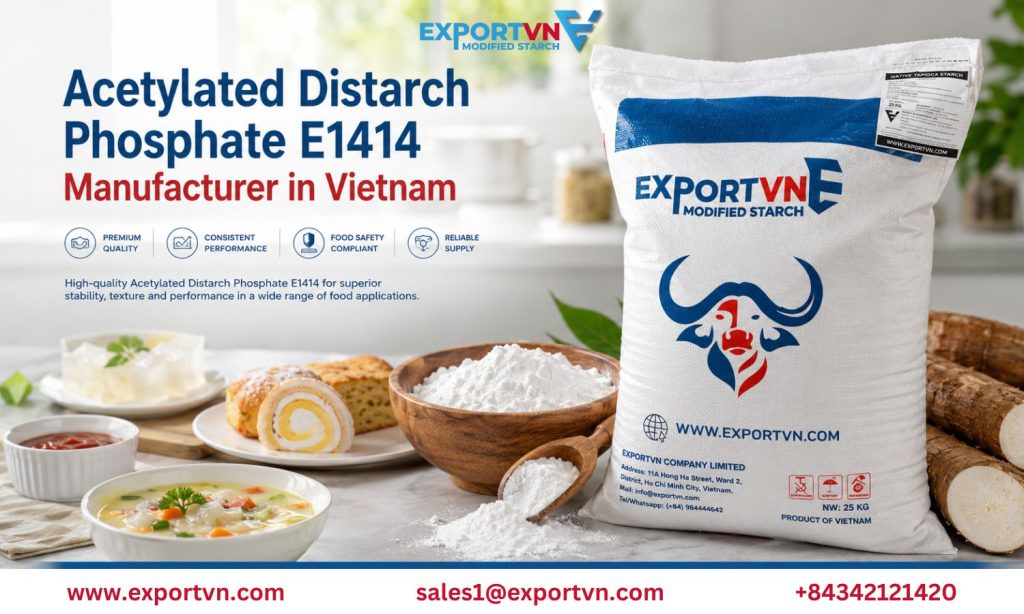
Acetylated Distarch Phosphate E1414 Manufacturer in Vietnam
Jul
Choosing a reliable Acetylated Distarch Phosphate E1414 manufacturer in Vietnam is important for food companies that require stable viscosity, consistent texture and dependable export support. EXPORTVN CO., LTD supplies tapioca-based E1414 to food manufacturers, ingredient distributors and global importers.
Produced from Vietnam-origin tapioca starch, E1414 combines heat and shear resistance with good water retention and freeze-thaw stability. Moreover, it can deliver a smooth texture while reducing water separation during storage. Therefore, manufacturers often evaluate it for sauces, frozen foods, meat products, fillings and ready meals.
Explore Acetylated Distarch Phosphate E1414 or contact EXPORTVN to request a sample, technical documents or application advice.
What Is Acetylated Distarch Phosphate E1414?
Acetylated Distarch Phosphate is a food-grade modified starch identified as INS 1414 or E1414. It may also be described as modified starch E1414, modified tapioca starch E1414 or acetylated phosphate starch.
According to the Codex General Standard for Food Additives, INS 1414 has functional roles as a thickener, stabilizer and emulsifier. However, food categories and permitted usage conditions vary between markets. Buyers should therefore confirm the regulations of the destination country.
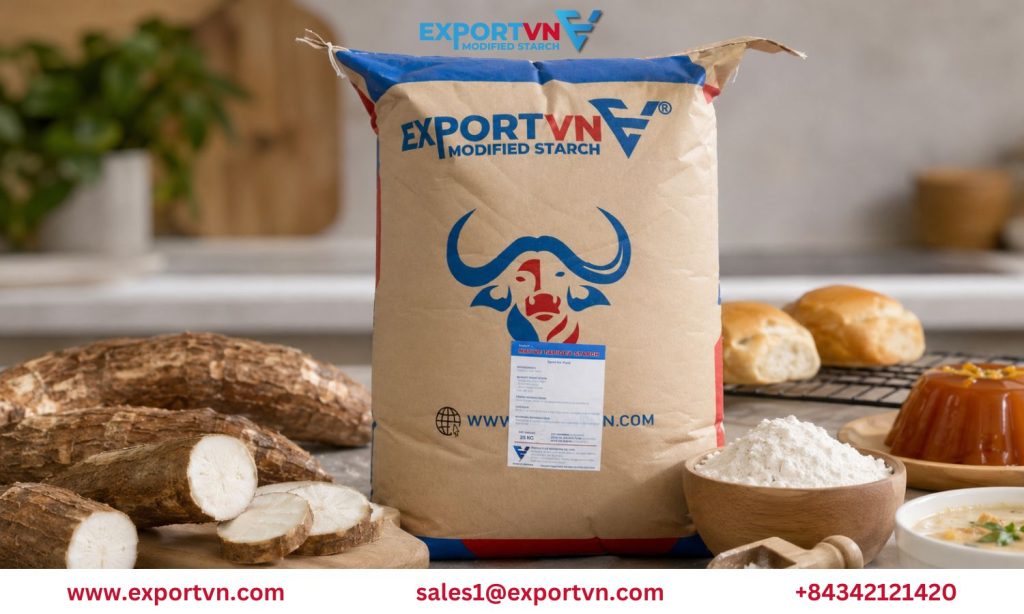
How Acetylated Distarch Phosphate Is Produced
E1414 is a dual-modified starch. In simple terms, the production process combines phosphate cross-linking with acetylation.
Phosphate Cross-Linking
Cross-linking strengthens the internal structure of starch granules. As a result, the starch can better control swelling during cooking.
This modification may provide:
- Improved heat resistance
- Better stability during high-speed mixing
- Reduced viscosity breakdown
- More consistent performance during pumping
- Better tolerance in continuous production lines
Acetylation
Acetylation helps reduce the tendency of cooked starch to retrograde during cooling and storage. Consequently, the finished food may retain a softer and smoother texture.
In addition, acetylation can improve freeze-thaw stability and reduce syneresis. These advantages are especially useful in chilled and frozen products.
The official JECFA modified starch specifications describe E1414 as starch treated through phosphate cross-linking combined with esterification using acetic anhydride or vinyl acetate.
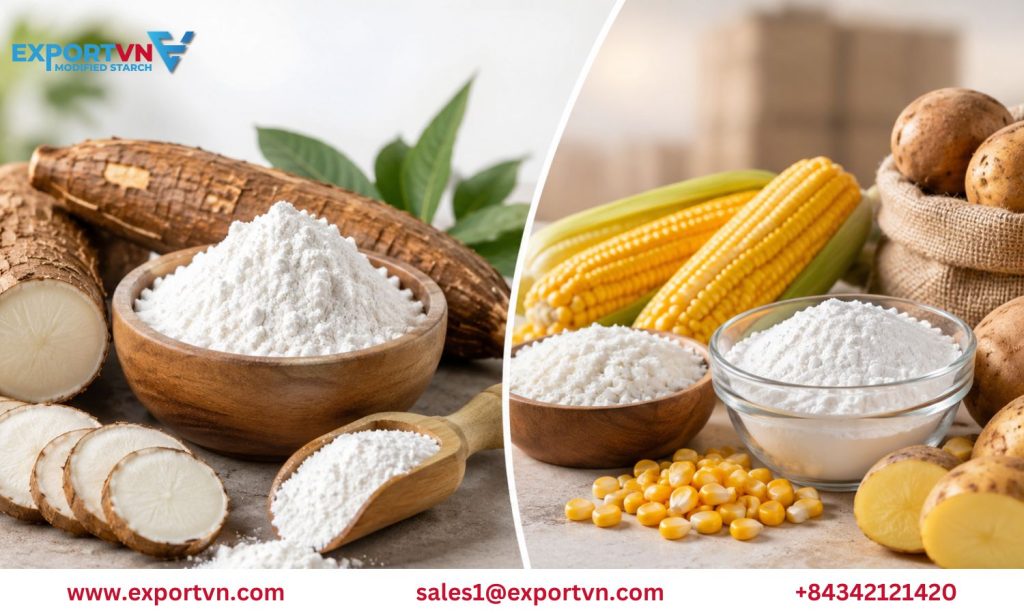
Tapioca-Based E1414 vs. Other Starch Sources
E1414 can be produced from tapioca, corn, waxy corn, wheat or potato starch. Nevertheless, the botanical source affects its texture, appearance and viscosity profile.
| Factor | Tapioca-Based E1414 | Corn or Potato-Based E1414 |
|---|---|---|
| Flavor | Generally neutral | Depends on starch source |
| Paste appearance | Smooth and often bright | Varies by source |
| Texture | Soft and clean mouthfeel | May be firmer or heavier |
| Viscosity | Depends on product grade | Depends on product grade |
| Replacement | Requires testing | Requires testing |
Although the products have the same E-number, they may not perform identically. Therefore, direct one-to-one substitution is not always recommended.
Key Properties and Functional Benefits of E1414
E1414 combines processing tolerance with storage stability. For this reason, it is suitable for many industrial food systems that are too demanding for native starch.
Heat and Shear Stability
During food production, starch may be exposed to cooking, strong agitation, pumping or homogenization. Native starch can break down under these conditions and lose viscosity.
By contrast, a suitable E1414 grade can maintain a more stable paste structure during:
- High-temperature cooking
- High-speed mixing
- Pumping through production lines
- Mechanical processing
- Extended heating
- Reheating before consumption
However, actual performance depends on pH, dosage, solids content and equipment.
Freeze-Thaw Stability and Reduced Syneresis
Freezing may damage a starch gel and cause water to separate after thawing. E1414 can help limit this problem.
Furthermore, it may maintain product body during chilled or frozen storage. Therefore, food manufacturers often consider it for frozen sauces, fillings, desserts, dumplings and ready meals.
Water Retention, Binding and Texture
The right modified tapioca starch E1414, Acetylated Distarch Phosphate E1414 Manufacturer in Vietnam can support water management throughout processing and storage. As a result, manufacturers may achieve:
- Stable and uniform viscosity
- Better water retention
- Reduced cooking loss
- Improved ingredient binding
- Smooth texture and mouthfeel
- Lower risk of water separation
- More consistent production batches
E1414 vs. E1412, E1422 and E1442
Several modified starches provide processing stability. Nevertheless, each type has a different modification system.
| Product | Modification | Main Selection Consideration |
| E1412 | Phosphate cross-linked | Heat and shear stability |
| E1414 | Acetylated and phosphate cross-linked | Processing and freeze-thaw stability |
| E1422 | Acetylated and adipate cross-linked | Smooth texture and frozen storage |
| E1442 | Hydroxypropylated and phosphate cross-linked | Strong processing and storage stability |
This table provides initial guidance only. Ultimately, the best option depends on processing temperature, pH, fat, protein, total solids and target texture.
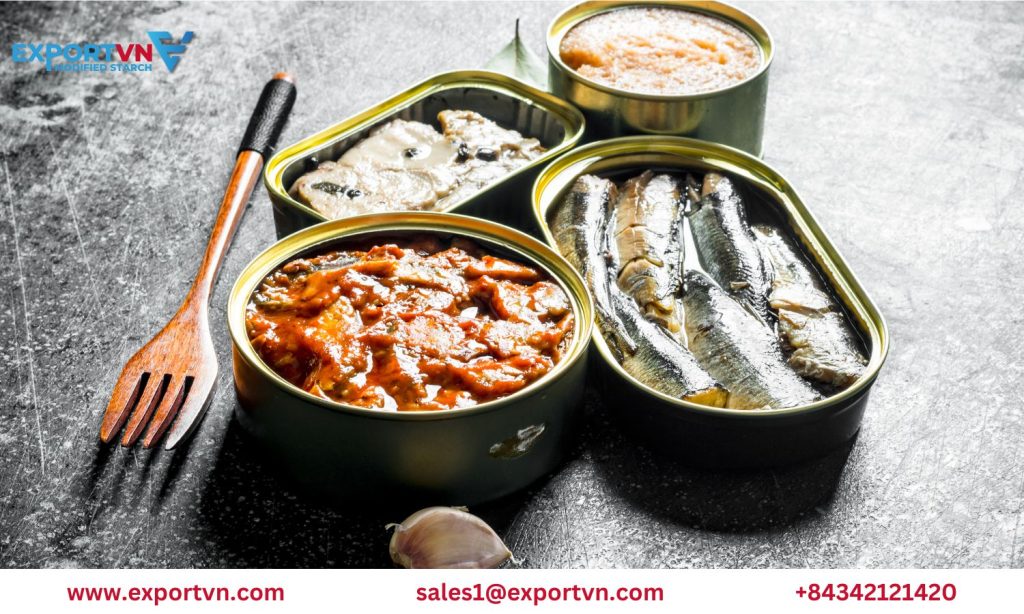
Food Applications of Acetylated Distarch Phosphate E1414
Because E1414 offers both processing and storage stability, it can support various food applications. Still, the viscosity grade and dosage should be selected according to the final formulation.
Sauces, Soups and Gravies
In chili sauce, ketchup, dipping sauces, gravies and soup concentrates, E1414 can create stable thickness and improve cling.
Moreover, its shear resistance helps maintain viscosity during mixing and pumping. Its water-binding ability may also reduce separation during storage.
Frozen Foods and Ready Meals from Tapioca-Based E1414
Frozen sauces, dumplings, fillings and prepared meals require stable texture after thawing. Therefore, freeze-thaw performance is an important selection factor.
E1414 can help reduce water release after defrosting. Meanwhile, its heat stability may support consistent viscosity when the food is reheated.
Processed Meat and Seafood Products
E1414 may improve water retention and binding in sausages, meatballs, ham, fish balls and surimi products.
Consequently, manufacturers may obtain:
- Better juiciness
- Lower cooking loss
- Improved product yield
- More stable structure
- Better slicing or biting texture
Nevertheless, final performance also depends on meat quality, protein extraction, phosphate level, fat content and cooking conditions.
Dairy, Fillings and Bakery Products
Selected E1414 grades may support body, smoothness and storage stability in dairy desserts, cream fillings, fruit fillings, custard-style products and glazes.
However, proteins, fats, sugar, acid and hydrocolloids may change starch behavior. Laboratory testing is therefore necessary before commercial use.
Noodles and Convenience Foods
In noodle applications, modified starch may support texture, water management and cooking stability. It can also help maintain consistency in instant meal sauces and convenience foods.
The correct grade depends on whether the product is fresh, dried, frozen or instant.
Why Choose EXPORTVN as Your Acetylated Distarch Phosphate E1414 Manufacturer in Vietnam?
Vietnam has an established cassava-growing and tapioca-processing industry. Consequently, the country offers a strong sourcing base for tapioca-derived food ingredients.
EXPORTVN combines Vietnam-origin raw materials with quality control, product selection and export coordination.
Food Safety and Quality Control
Depending on the selected product and current certification scope, customers may request:
- ISO 22000
- HACCP
- Halal certification
- Kosher certification
- Product Specification
- Certificate of Analysis
- Technical Data Sheet
- Safety Data Sheet
In addition, batch traceability supports quality verification and product identification. Buyers should confirm the validity and applicable scope of each certificate before placing an order.
Technical and Application Support
EXPORTVN considers the customer’s application rather than recommending one E1414 grade for every formula.
For example, the technical team may review:
- Product pH
- Cooking temperature
- Mixing speed
- Required viscosity
- Freeze-thaw conditions
- Target texture
- Storage method
Samples and suggested dosage ranges may also be provided for initial trials. Thus, manufacturers can evaluate performance before proceeding with commercial quantities.
Packaging and Export Services
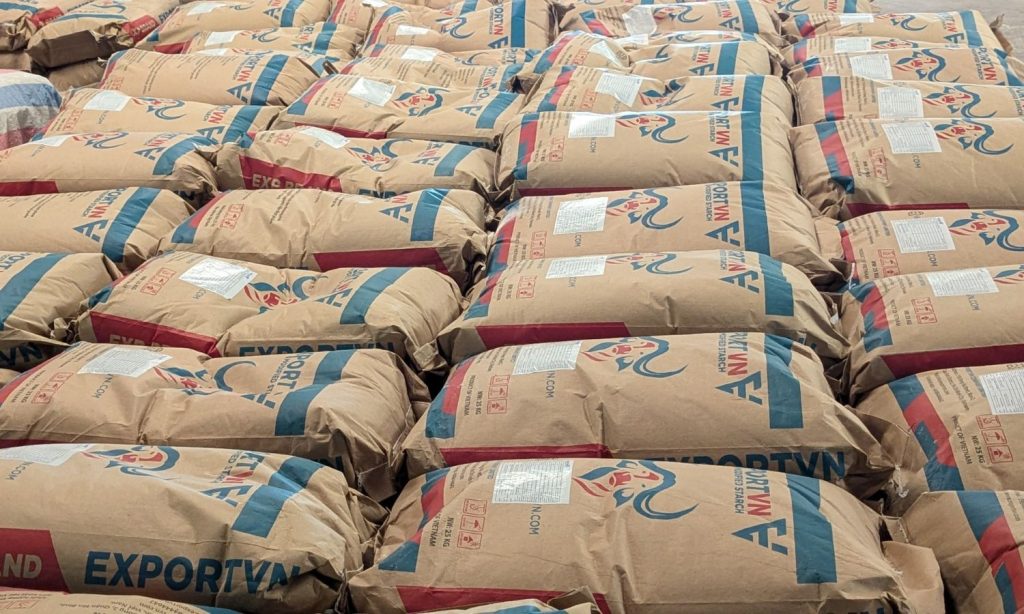
Standard E1414 packaging is typically 25 kg per bag. Depending on the agreement, other commercial solutions may include:
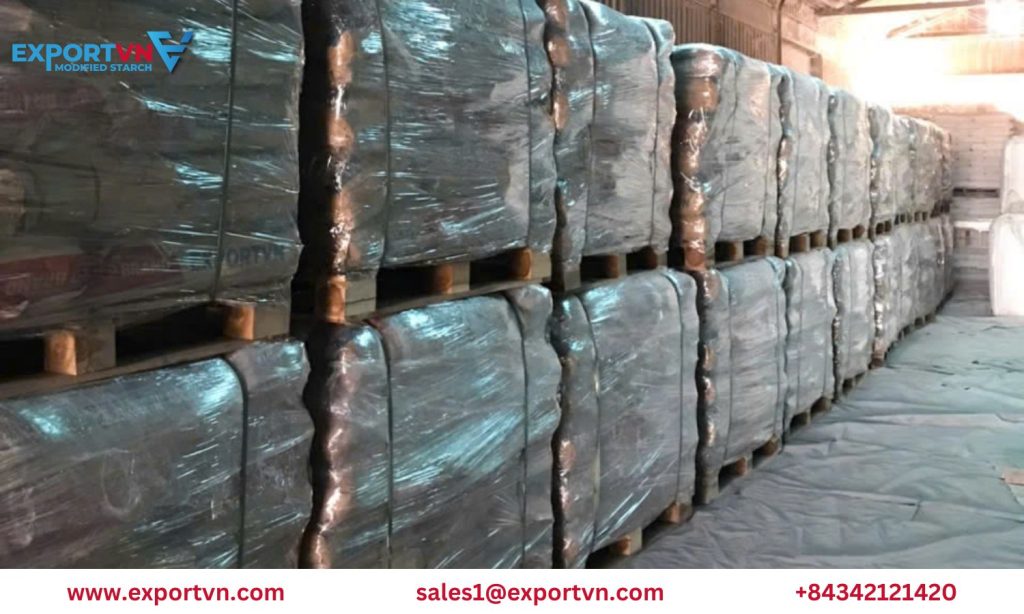
- Palletized or non-palletized loading
- OEM or private-label packaging
- Full-container shipments
- FOB, CFR or CIF terms
- Export documentation support
- Technical document preparation
Furthermore, EXPORTVN supports customers in international markets with product selection, specifications and shipment coordination.
How to Select and Buy E1414 from Vietnam
To receive an accurate product recommendation, buyers should provide:
- Final food application
- Current starch name or code
- Required viscosity and texture
- Processing temperature
- Product pH
- Mixing or shear conditions
- Frozen or chilled storage requirements
- Required documents and certifications
Sample Testing and Dosage Evaluation
There is no single dosage suitable for every application. Instead, the required amount depends on water content, total solids, fat, protein, sugar, salt and other stabilizers.
Therefore, buyers should complete a laboratory trial first. Afterwards, a pilot test can confirm cooking stability, final texture and shelf-life performance.
Quotation Requirements
For a commercial quotation, please provide:
- Required quantity
- Packaging preference
- Trial or full-container order
- Destination port
- Preferred Incoterm
- Expected delivery schedule
- OEM or private-label requirements
Frequently Asked Questions
Is E1414 the same as modified tapioca starch?
E1414 is one specific type of modified starch. However, it may be produced from several botanical sources. Buyers should therefore confirm that the selected product is tapioca-based.
Is E1414 suitable for frozen foods?
E1414 is commonly evaluated for products that require freeze-thaw stability. Nevertheless, actual performance should be tested in the customer’s formulation.
Can E1414 replace E1422?
Replacement may be possible in some products. However, a one-to-one substitution is not guaranteed because the two starches use different cross-linking systems.
What is the typical dosage of E1414?
Dosage depends on the application, processing method, target texture and local food regulations. Therefore, sample testing is recommended.
For samples, technical documents or a quotation, contact EXPORTVN:
- Email: sales1@exportvn.com
- WhatsApp: +84 342 121 420
- Website: EXPORTVN – Acetylated Distarch Phosphate E1414 Manufacturer in Vietnam
