


Common types of modified starch, Market Update
Modified Tapioca Starch Manufacturer in Vietnam
Jul
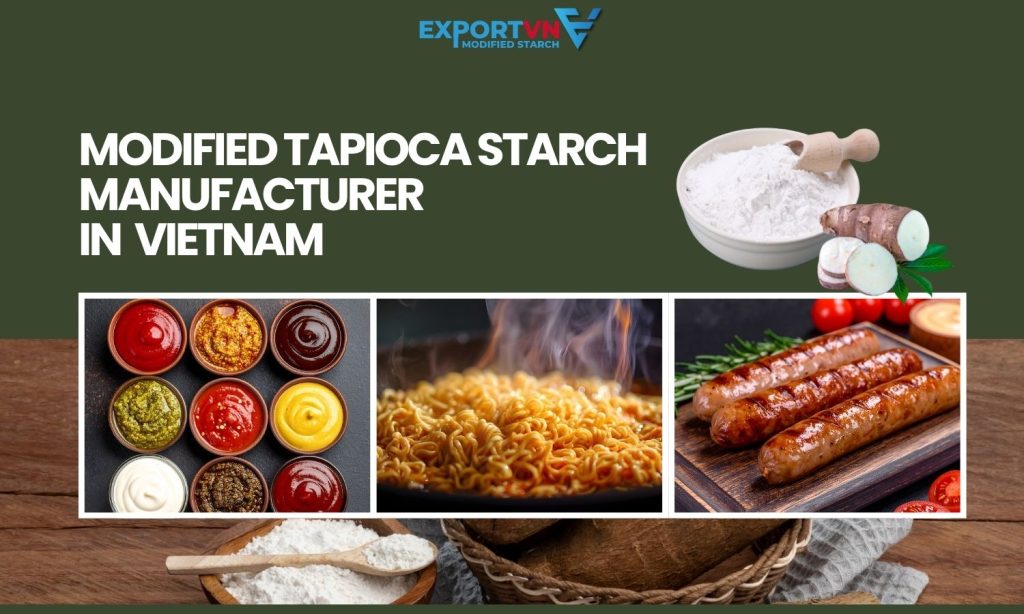
Finding a reliable modified tapioca starch manufacturer in Vietnam is important for food companies seeking stable quality, suitable functionality and professional export support. EXPORTVN CO., LTD supplies Vietnam-origin tapioca starch solutions to food manufacturers, ingredient distributors and international importers.
Compared with native starch, modified tapioca starch can offer better resistance to heat, acid and mechanical shear. Depending on the grade, it may also improve thickening, water retention, freeze-thaw stability and finished-product consistency. These benefits make it suitable for sauces, meat products, dairy foods, noodles and frozen foods.
Explore the product options below or contact EXPORTVN for a recommendation based on your formulation and processing conditions.
What Is Modified Tapioca Starch?
Modified tapioca starch is made from native starch extracted from cassava roots. The starch is adjusted through approved physical, enzymatic or chemical processes to improve specific functional properties.
International INS numbers identify different modified starch categories, as described in the official JECFA specifications for modified starches.
How Modified Tapioca Starch Is Produced
Production begins with purified native tapioca starch. Depending on the desired performance, manufacturers may cross-link, acetylate, hydroxypropylate, oxidize or pregelatinize the starch under controlled conditions.
Cross-linking, for example, generally strengthens the starch granule and improves resistance to heat and shear. Meanwhile, acetylation or hydroxypropylation can support smoother texture, lower retrogradation and better storage stability.
Each modification has a different purpose. Consequently, buyers should select a grade according to the complete food system rather than viscosity alone.
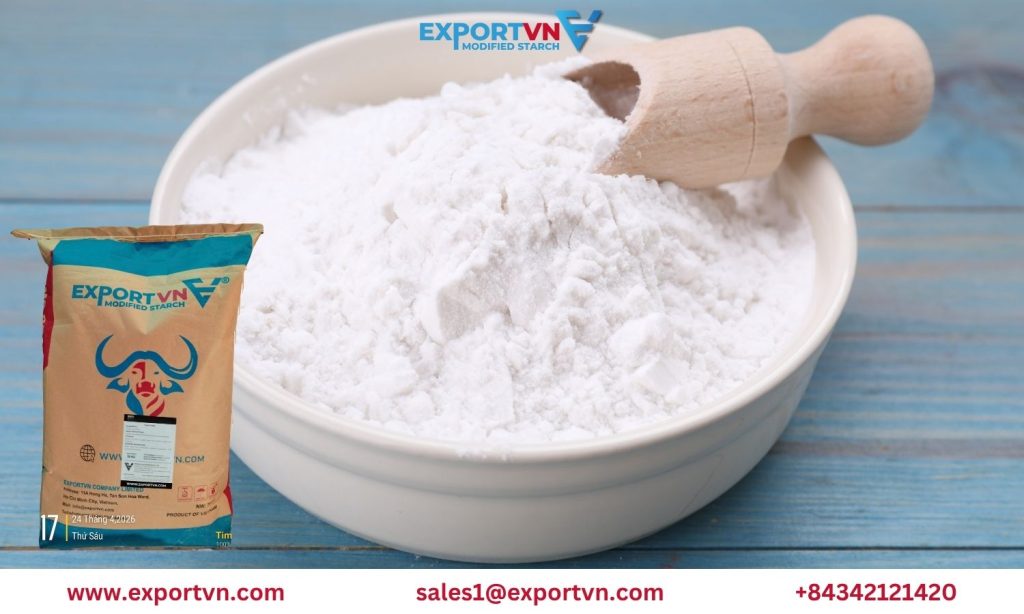
Modified Tapioca Starch vs. Native Tapioca Starch
| Property | Native Tapioca Starch | Modified Tapioca Starch |
|---|---|---|
| Heat stability | Limited under severe processing | Improved, depending on grade |
| Acid resistance | May lose viscosity | Better in selected grades |
| Shear resistance | Lower | Improved for industrial mixing |
| Freeze-thaw stability | Generally limited | Available in suitable grades |
| Main use | General thickening | Controlled industrial performance |
Native tapioca starch is suitable for many general thickening purposes. However, modified tapioca starch is often preferred when production involves high temperatures, low pH, strong mixing, retort processing or frozen storage.production involves high temperatures, low pH, strong mixing, retort processing, freezing or extended storage.
Key Functional Benefits
Depending on the selected grade, modified tapioca starch can offer:
- Controlled thickening and viscosity
- Improved heat, acid and shear resistance
- Better freeze-thaw stability
- Increased water binding
- Reduced syneresis and separation
- Smoother texture and mouthfeel
- More consistent finished-product quality
In addition, modified tapioca starch has a relatively neutral taste and light appearance. For this reason, it can support product texture without significantly changing the original flavor profile.
Food-Grade Modified Tapioca Starch Products
EXPORTVN offers several food-grade options. The best choice depends on processing conditions, target texture and storage method.
Distarch Phosphate – INS 1412 / E1412
Distarch Phosphate E1412 provides stable viscosity and good heat and shear resistance. It is commonly considered for sauces, soups, processed meat, noodles and canned foods.
Acetylated Distarch Phosphate – INS 1414 / E1414
Acetylated Distarch Phosphate E1414 combines processing tolerance, water binding and freeze-thaw stability. Typical applications include sauces, dairy foods, frozen products and fillings.
Acetylated Starch – INS 1420 / E1420
Acetylated Starch E1420 helps create a smooth texture and may reduce retrogradation or water separation. It can be used in selected sauces, desserts and fillings.
Acetylated Distarch Adipate – INS 1422 / E1422
Modified Tapioca Starch E1422 offers strong heat, shear and freeze-thaw stability. It is widely considered for sauces, mayonnaise, yogurt, frozen foods and processed meat.
Hydroxypropyl Starch – INS 1440 / E1440
Modified Tapioca Starch E1440 supports smooth mouthfeel, stable viscosity and reduced syneresis in dairy desserts, bakery fillings, sauces and convenience foods.
Hydroxypropyl Distarch Phosphate – INS 1442 / E1442
E1442 – modified tapioca starch manufacturer in Vietnam provides strong heat, shear and freeze-thaw stability for sauces, soups, frozen foods, dairy products and ready meals.
Starch Sodium Octenyl Succinate – INS 1450 / E1450
Starch Sodium Octenyl Succinate E1450 can act as an emulsifier and encapsulating agent in oil-in-water systems, beverage emulsions, flavors, drink powders, dressings and mayonnaise.
Modified Tapioca Starch manufacturer in Vietnam: Applications in Food Manufacturing
The end application determines which starch property matters most. Therefore, buyers should evaluate the full processing environment before selecting a product.
Sauces, Dressings and Condiments
In chili sauce, ketchup, gravies, mayonnaise and salad dressings, modified tapioca starch can build viscosity, improve cling and reduce water separation.
Acidic sauces, however, may require a grade with stronger acid resistance. Likewise, high-speed mixing or prolonged cooking may call for better shear and heat stability.
Processed Meat and Seafood Products
Modified starch can support water retention, binding and juiciness in sausages, meatballs, ham, fish balls and surimi products.
During cooking, water and fat loss can negatively affect texture and yield. Consequently, a suitable modified starch may help maintain structure while reducing processing loss.
Dairy and Analogue Cheese Products
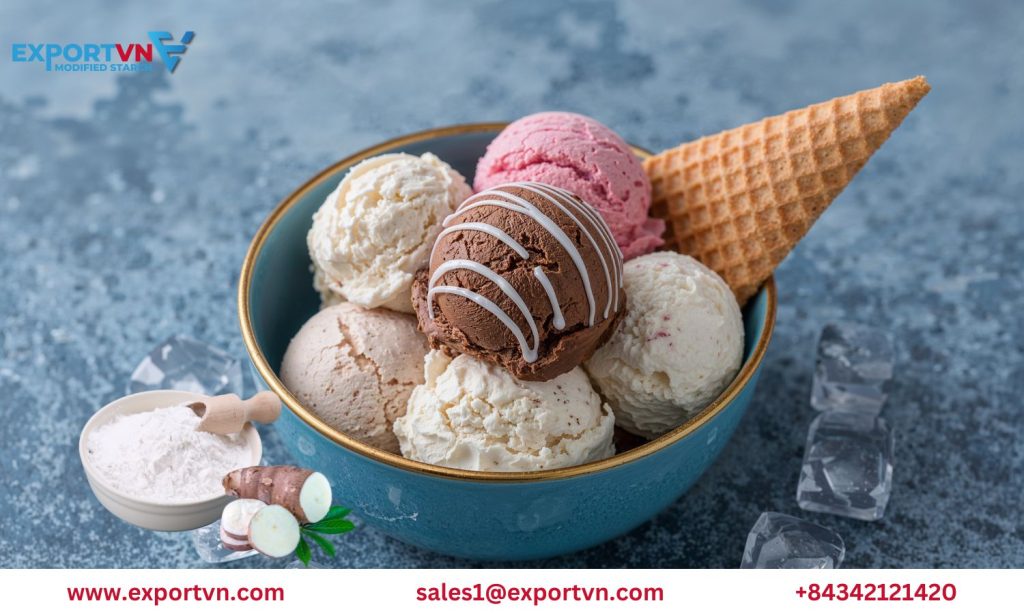
Selected modified starches can improve creaminess, body and stability in yogurt, dairy desserts, processed cheese, analogue cheese and non-dairy products.
However, starch performance can be affected by proteins, fats, salts and emulsifying systems. For this reason, application trials are recommended before commercial production.
Noodles, Bakery and Convenience Foods
In noodle products, modified tapioca starch may improve bite, elasticity and cooking stability. Meanwhile, in instant soups and ready meals, it can provide controlled viscosity during preparation and reheating.
Bakery fillings also benefit from improved water retention and reduced leakage. In addition, selected grades can help preserve texture during chilled or frozen storage.
Frozen and Canned Foods
Frozen foods require starch that can withstand repeated freezing and thawing without excessive water separation. Therefore, E1414, E1422 and E1442 are often evaluated for these applications.
Canned and retorted foods, on the other hand, require viscosity stability during high-temperature processing. Nevertheless, the final grade and dosage should always be confirmed through testing under actual production conditions.
Why Choose EXPORTVN as Your Modified Tapioca Starch Manufacturer?
Vietnam has a strong cassava-growing base and established export infrastructure. As a result, the country is well positioned to supply tapioca-based ingredients to international markets.
EXPORTVN combines Vietnam-origin raw materials with food-application knowledge and export support. Therefore, customers can receive assistance from product selection through commercial shipment.
EXPORTVN – Modified tapioca starch manufacturer in Vietnam.
Consistent Food-Grade Quality
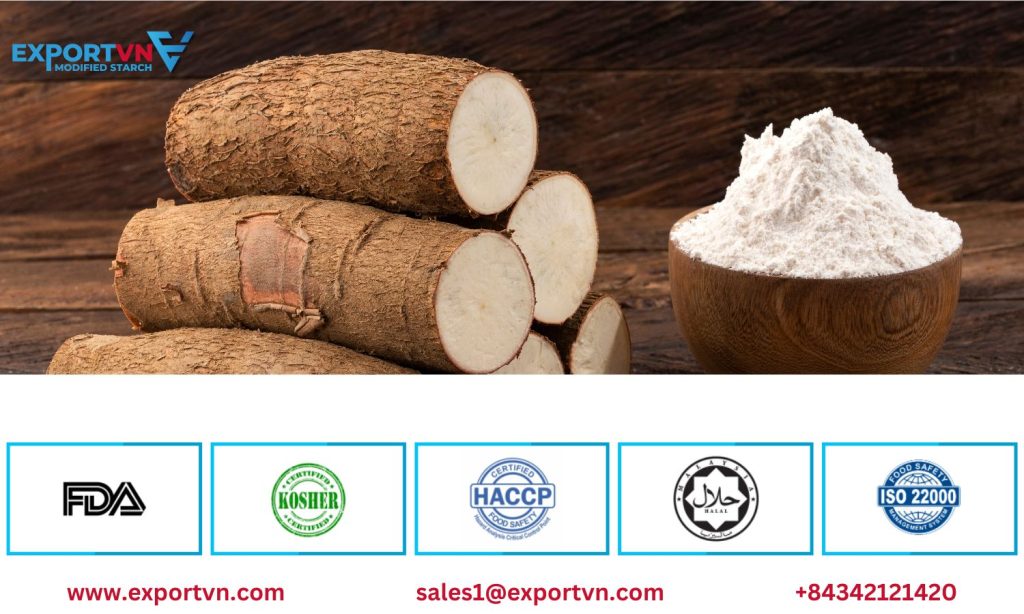
Quality control covers raw materials, production batches and finished products. Depending on the product and current certification scope, supporting documents may include:
- ISO 22000
- HACCP
- Halal and Kosher certificates
- Certificate of Analysis
- Technical Data Sheet
- Safety Data Sheet
In addition, batch control supports product traceability. Buyers should still confirm the current validity and scope of each certificate before placing an order.
Application and Technical Support
EXPORTVN helps customers compare starch grades according to pH, temperature, mixing conditions, target viscosity and storage requirements.
For instance, a starch designed for frozen sauce may not perform in the same way as one intended for retorted meat products. Thus, understanding the customer’s process is essential for accurate product selection.
Product samples and dosage recommendations may also support laboratory or factory trials. As a result, customers can evaluate performance before ordering commercial quantities.
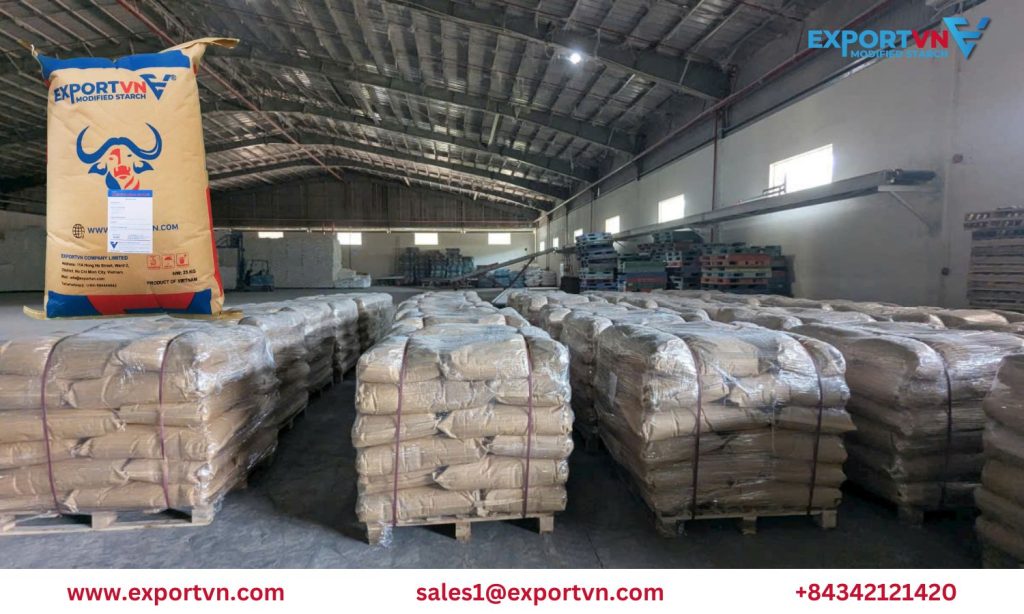
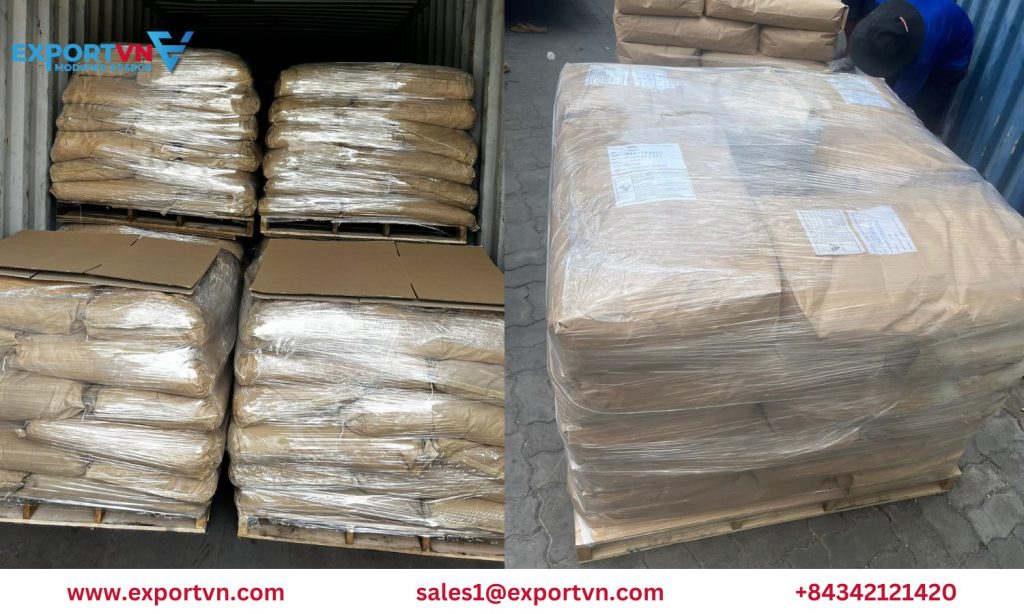
Flexible Packaging and Export Solutions
Products may be supplied in 20 kg or 25 kg bags, depending on the grade and commercial agreement. Available solutions may include:
- Palletized or non-palletized loading
- OEM or private-label packaging
- Full-container shipments
- FOB, CFR or CIF delivery terms
- Export and technical documentation support
International Market Experience
EXPORTVN supports customers across Asia, Europe, the Middle East, Africa and the Americas. In addition, the team assists with product specifications, document preparation and shipment coordination for international orders.
This combination of product knowledge and export experience allows customers to work with one partner throughout product selection, testing and commercial delivery.
How to Buy Modified Tapioca Starch from Vietnam
For an accurate recommendation and quotation, buyers should provide:
- Food application and current starch grade
- Processing temperature, pH and mixing conditions
- Target viscosity, texture and shelf life
- Freeze-thaw or retort requirements
- Required documents and certifications
- Order quantity and packaging
- Destination port and preferred Incoterm
A sample, TDS, COA, SDS and available certification documents can be requested before ordering.
Frequently Asked Questions
Is modified tapioca starch gluten-free?
Tapioca is naturally gluten-free. However, buyers requiring a formal gluten-free claim should confirm the specific product declaration, production controls and cross-contact assessment with the supplier.
Can modified tapioca starch replace modified corn starch?
It may replace modified corn starch in some applications, but not automatically at a one-to-one ratio. Tapioca and corn starch have different pasting, texture and sensory characteristics. Therefore, an application trial is recommended.
Which modified tapioca starch is suitable for sauces?
The choice depends on pH, cooking temperature, mechanical shear, required viscosity and storage conditions. E1412, E1414, E1422 or E1442 may be evaluated according to the process.
How can buyers receive a quotation?
Send the product type, quantity, packaging, destination port and preferred Incoterm. Providing application and processing details will help EXPORTVN recommend a more suitable grade.
For technical consultation, product samples or a commercial quotation, contact EXPORTVN:
- Email: sales1@exportvn.com
- WhatsApp: +84 342 121 420
- Website: EXPORTVN – Tapioca Starch and Food Ingredients
