


Common types of modified starch, Properties of starch
INS 1450 Specification: Technical Data Sheet and Certificate of Analysis
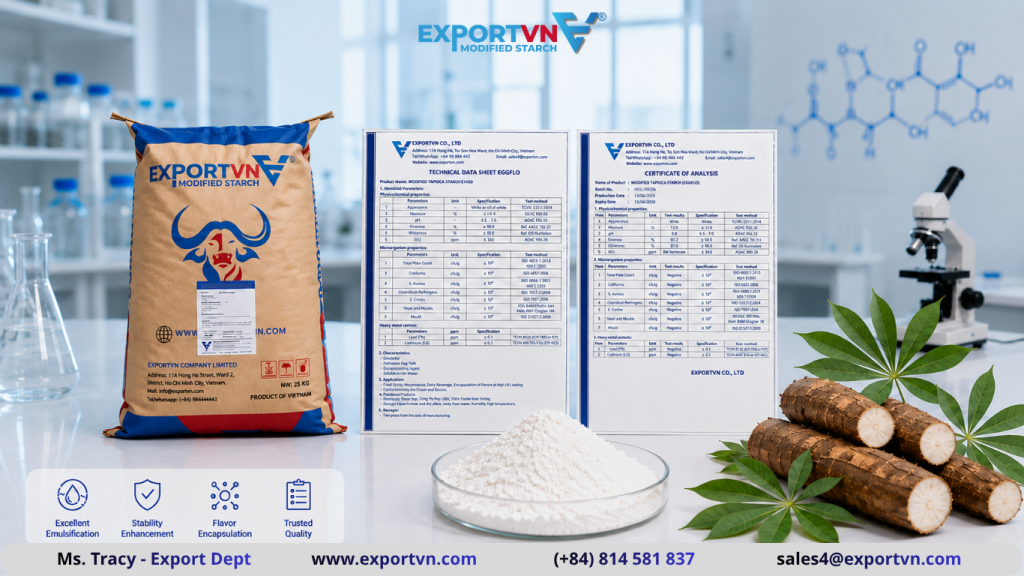
Jun
Purchasing premium ingredients for food, beverage manufacturing requires more than simply reviewing a product name. Technical performance, food safety compliance, process compatibility, and batch consistency are equally important. For this reason, manufacturers and importers often request the complete INS 1450 Specification, including the Technical Data Sheet (TDS) and Certificate of Analysis (COA) before approving a supplier.
INS 1450, also known as Starch Sodium Octenyl Succinate (SSOS), OSA Starch, E1450, Modified Tapioca Starch E1450, or Modified Tapioca Starch INS 1450, is one of the most widely used modified starches for emulsification, stabilization, and flavor encapsulation.
This article explains the key technical parameters found in the TDS and COA documents and why they matter to R&D teams, quality managers, and procurement professionals.
What Is INS 1450?
INS 1450 is a modified tapioca starch produced by reacting native tapioca starch with Octenyl Succinic Anhydride (OSA). This modification introduces both hydrophilic and lipophilic functional groups onto the starch molecule, allowing it to interact with water and oil simultaneously.
Because of this amphiphilic structure, OSA starch functions as an effective emulsifier and encapsulating agent. Compared with native starch, it offers superior emulsion stability, improved oil retention, and enhanced flavor protection.
Today, Modified Tapioca Starch E1450 is commonly used in:
- Eggless mayonnaise
- Salad dressing
- Dairy beverages
- Non-dairy creamers
- Flavor encapsulation
- Instant beverage systems
- Bakery fillings
At EXPORTVN Co., Ltd., we provide two main types of INS 1450 for different food applications:
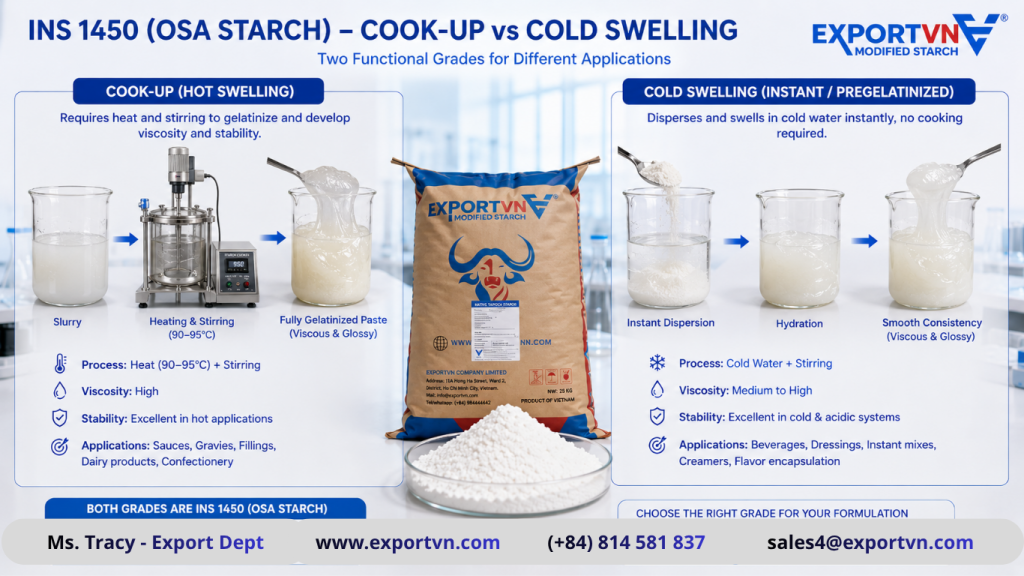
INS 1450 Pregelatinized
Modified Tapioca Starch E1450 Pregelatinized is a pre-cooked starch that can disperse and function in cold water without additional heating. Therefore, it is highly suitable for instant powder products, dry beverage mixes, nutritional powders, and cold-process applications.
INS 1450 Cook-Up
This type requires heating during processing to fully develop viscosity and functionality. Moreover, manufacturers commonly use starch sodium octenyl succinate E1450 Cook-Up in beverages, sauces, dairy products, and processed food systems that involve thermal treatment.
INS 1450 Specification: Physical & Chemical Parameters
Understanding the technical specifications of E1450 helps product developers optimize formulations and maintain consistent product quality.
Physicochemical Parameter Breakdown
| Parameter | What Is This? | Why It Matters to R&D |
|---|---|---|
| Appearance | The visual state and color description of the starch powder. | Ensures product consistency and prevents color interference in finished food systems. |
| Moisture | The amount of free water remaining after drying. | Influences shelf life, storage stability, and formulation calculations. |
| pH (10% Slurry) | Acidity or alkalinity of the starch suspension. | Affects ingredient compatibility and formulation stability. |
| Fineness | Particle size distribution of the powder. | Influences hydration speed, dispersion, and mouthfeel. |
| Whiteness | Brightness level of the powder. | Indicates raw material purity and processing quality. |
| SO₂ Residual | Remaining sulfur dioxide from starch extraction. | Supports food safety compliance and export requirements. |
Appearance
Appearance describes the visual quality of Modified Tapioca Starch INS1450. High-quality starch should exhibit a uniform white powder appearance without discoloration, foreign particles, or visible impurities.
From an R&D perspective, appearance affects both product quality and manufacturing efficiency.
Why it matters:
- Maintains the desired color of finished products.
- Supports premium visual quality.
- Facilitates accurate weighing and dry blending.
- Reduces the risk of powder segregation during processing.
For example, mayonnaise manufacturers require a bright white starch that does not alter the creamy appearance of the final product.
Moisture
Moisture indicates the amount of free water remaining in the starch after drying.
Although often overlooked, moisture is one of the most important quality indicators because it directly impacts storage stability and microbiological safety.
Why it matters:
- Prevents mold and microbial growth.
- Extends product shelf life.
- Reduces caking during storage.
- Improves powder flowability.
Moisture content also helps formulation engineers calculate the exact dry matter contribution of the starch.
In general, Cold Swelling INS 1450 requires lower moisture than Hot Swelling grades to minimize moisture absorption during storage and transportation.
pH (10% Slurry)
The pH value measures the acidity or alkalinity of a starch suspension prepared at a specified concentration.
Maintaining a controlled pH range is critical for ingredient compatibility.
Why it matters:
- Protects dairy proteins from destabilization.
- Reduces flavor degradation.
- Improves process consistency.
- Supports long-term product stability.
A neutral-to-slightly acidic pH is generally preferred for most food applications.
Fineness
Fineness represents the percentage of powder passing through a standardized sieve.
Particle size significantly influences hydration and processing performance.
Why it matters:
- Accelerates dispersion.
- Improves dissolution speed.
- Reduces lump formation.
- Creates a smoother texture.
Fine particle distribution is especially important in sauces, creamers, and instant beverage systems.
Whiteness
Whiteness measures the brightness of the starch powder.
This parameter often reflects the quality of raw materials and processing efficiency.
Why it matters:
- Indicates product purity.
- Supports color-sensitive applications.
- Demonstrates effective washing and refining processes.
Higher whiteness values are typically preferred in dairy alternatives, mayonnaise, and cream-based products.
Sulfur Dioxide (SO₂) Residual
SO₂ residual refers to trace sulfur dioxide remaining after starch extraction.
Although present at very low levels, this parameter remains important for regulatory compliance.
Why it matters:
- Supports export market requirements.
- Helps meet food safety regulations.
- Facilitates clean-label positioning.
Many international buyers require strict control of sulfur dioxide residues before approving suppliers.
INS 1450 Specification: Microbiological & Heavy Metal Safety Standards
Beyond functional performance, food manufacturers must ensure that Starch Sodium Octenyl Succinate meets strict safety requirements.
Microbiological Specifications
Microbiological testing confirms that the product has been manufactured under hygienic conditions and is safe for food applications.
| Parameter | What Is This? | Why It Matters |
|---|---|---|
| Total Plate Count | Total aerobic microorganisms present. | Indicates overall manufacturing hygiene. |
| Yeast & Mold | Fungi that may affect product quality. | Helps maintain shelf life and storage stability. |
| Coliforms | Indicator bacteria for sanitation control. | Confirms hygienic processing conditions. |
| E. coli | Potential pathogenic bacterium. | Ensures food safety and absence of contamination. |
| Staphylococcus aureus | Foodborne pathogen. | Verifies microbiological safety. |
| Bacillus cereus | Spore-forming bacterium. | Prevents food safety risks in starch-based systems. |
| Clostridium perfringens | Pathogenic anaerobic bacterium. | Demonstrates compliance with food safety standards. |
Total Plate Count and Yeast & Mold
These parameters evaluate overall microbial quality.
Low counts indicate effective sanitation practices and help prevent spoilage during storage.
Pathogenic Microorganisms
Pathogens such as E. coli, Staphylococcus aureus, Bacillus cereus, and Clostridium perfringens must remain absent or below detection limits.
This ensures the ingredient can be safely used in sensitive applications such as dairy beverages, nutritional powders, and infant food systems.
INS 1450 Specification: Heavy Metal Contamination
Heavy metal testing protects consumers from environmental contamination.
Lead (Pb)
Lead may originate from soil, water, or industrial contamination.
Strict monitoring helps manufacturers comply with international food regulations and protect consumer health.
Cadmium (Cd)
Cadmium is another regulated heavy metal commonly monitored in food ingredients.
Maintaining low cadmium levels ensures compliance with food safety requirements in markets such as the European Union, United States, and Japan.
INS 1450 Specification: Technical Data Sheet (TDS)
The Technical Data Sheet establishes the official quality specifications for the product.
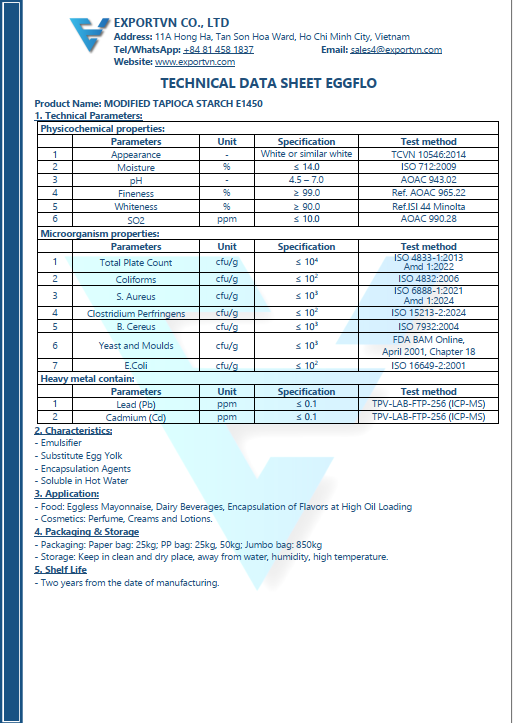
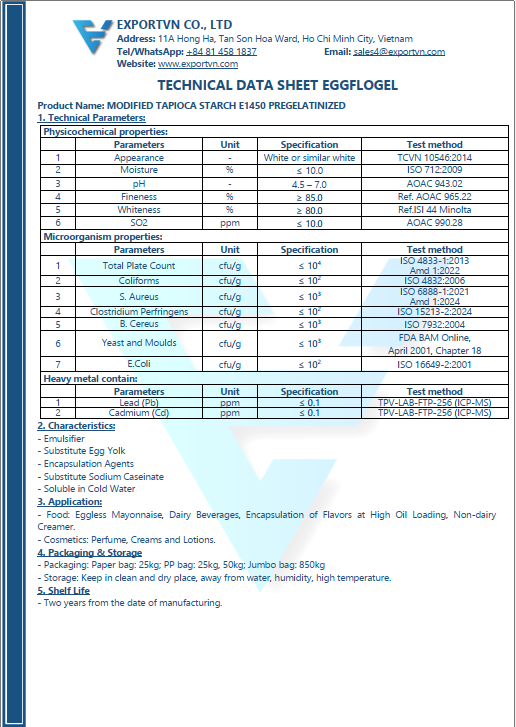
These specifications define the acceptable limits for physical, chemical, microbiological, and safety parameters.
INS 1450 Specification: Certificate of Analysis (COA)
While the TDS defines the required specifications, the Certificate of Analysis verifies the actual test results for a specific production batch.
The COA provides buyers with documented evidence that the delivered product complies with the established specifications.
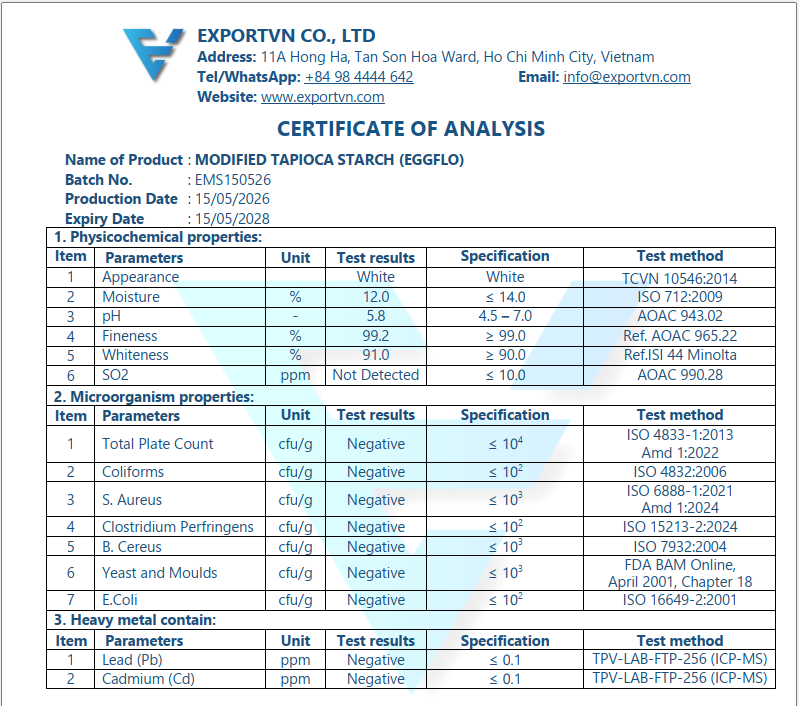
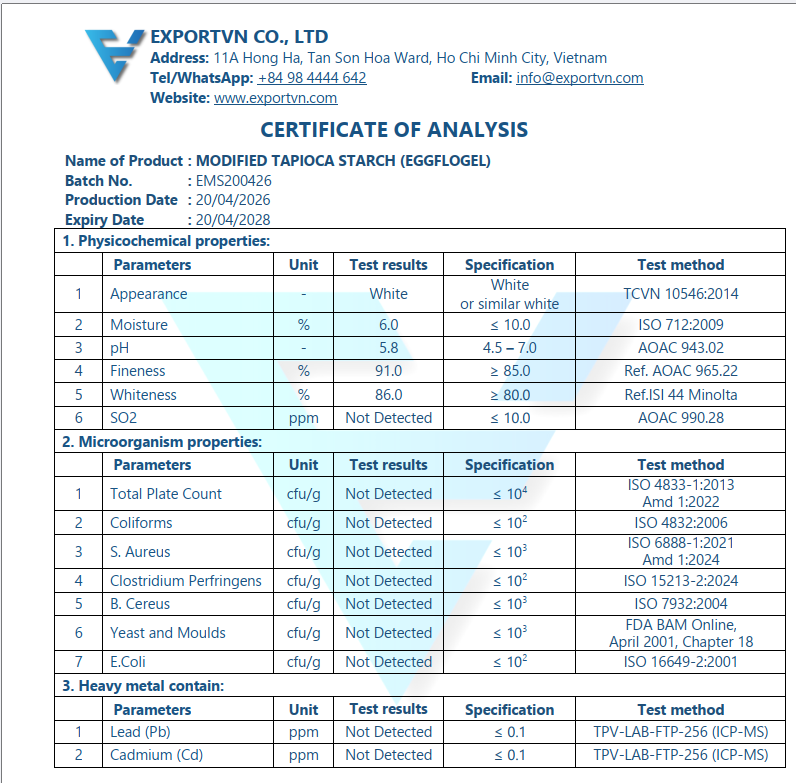
A compliant COA demonstrates:
- Consistent product quality.
- Batch-to-batch reliability.
- Food safety compliance.
- Export readiness.
Why Choose EXPORTVN?
EXPORTVN supplies high-quality INS 1450 products supported by complete technical documentation and professional export services.
Our advantages include:
- Consistent product quality.
- Complete TDS and COA documentation.
- Technical support for formulation development.
- Export experience in global markets.
- Sample availability for evaluation and testing.

Contact for inquiries and business cooperation:
Ms. Tracy Duong – Global Sales Executive
WhatsApp/ Mob: (+84) 814 581 837
Email: sales4@exportvn.com

Pingback: बफ़ेलो ब्रांड संशोधित टैपिओका स्टार्च का निर्माता कौन है?