


Common types of modified starch, Properties of starch
Why Do Fish Ball Manufacturers Request E1412 Samples First?
Apr
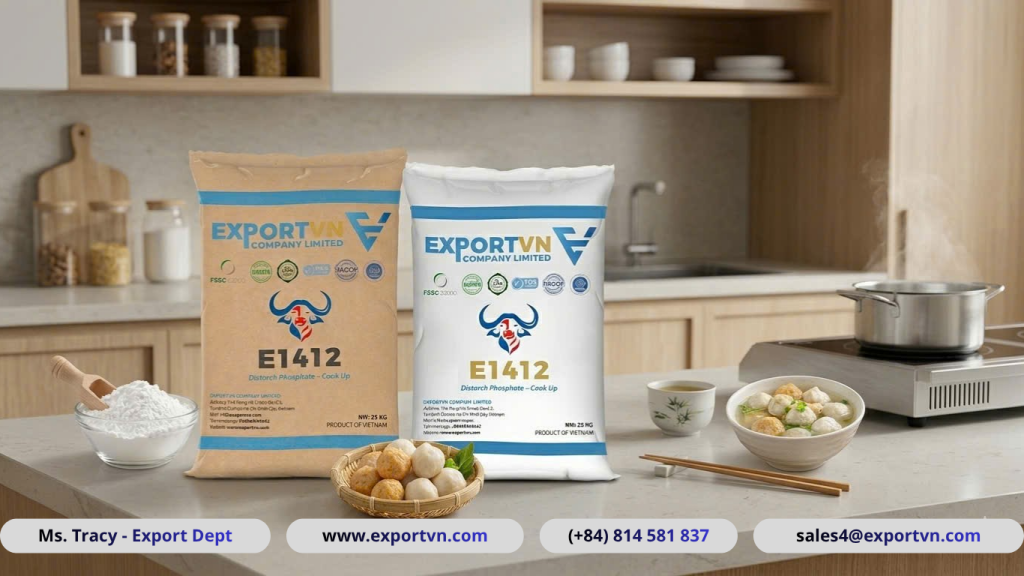
Fish ball manufacturers consistently request E1412 modified tapioca starch as the first sample. Also known as DISTARCH PHOSPHATE E1412, INS E1412, or simply E1412 starch, it serves as the industry’s starting benchmark for formulation development.
This preference is not random. Instead, it is driven by technical reliability, process stability, and cost efficiency—the three critical pillars of successful fish ball production.
With export experience in more than 25 countries, EXPORTVN has observed that most R&D teams begin their formulation trials with E1412 to establish a reliable baseline before optimizing with other starch solutions.
What Is E1412 Tapioca Starch and Why It Matters in Fish Ball Production
Understanding DISTARCH PHOSPHATE E1412
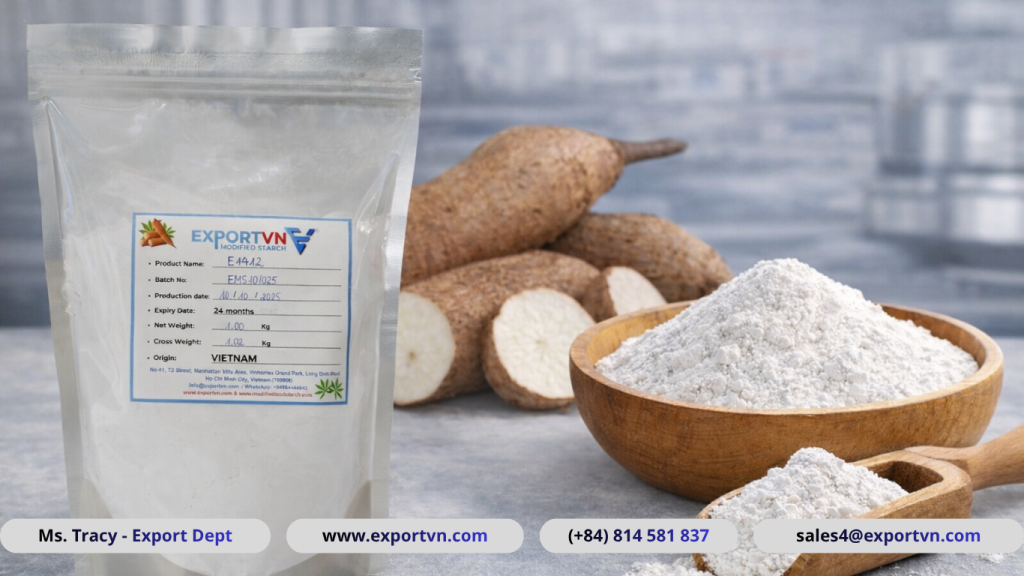
Specifically, E1412 is a cross-linked modified tapioca starch designed to perform under demanding food processing conditions. Its molecular structure allows it to resist high temperature, mechanical shear, and acidic environments.
Unlike native starch, INS E1412 maintains stable viscosity and structural integrity throughout processing. This makes it highly suitable for surimi-based applications, where consistency and structure are essential.
Functional Role in Surimi and Fish Balls
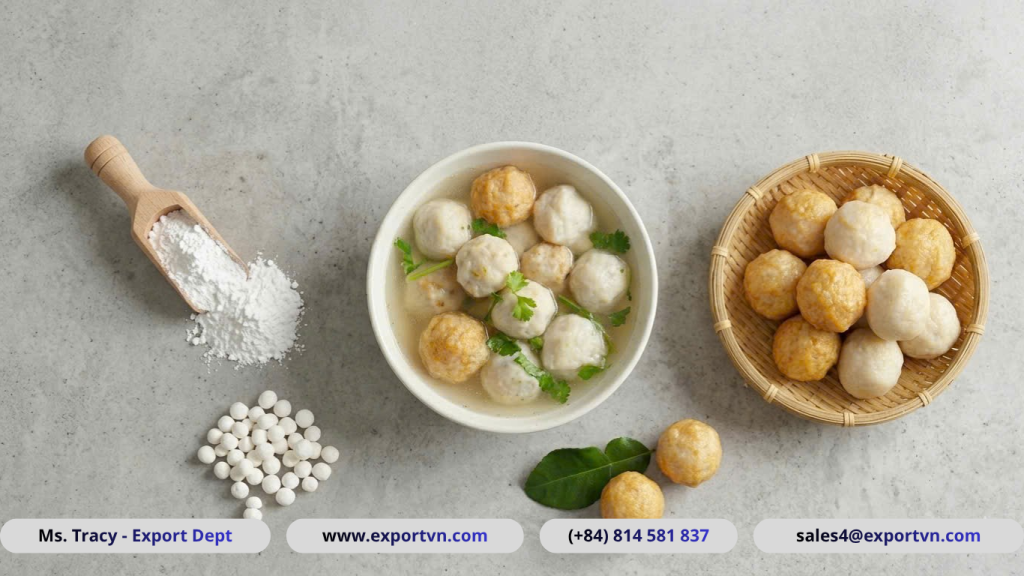
In addition, in fish ball production, E1412 plays a critical role in supporting the protein network of fish paste. It enhances binding, improves moisture retention, and contributes to the final texture.
As a result, manufacturers can achieve a more consistent product with better control over quality parameters.
Core Reasons Why Manufacturers Start with E1412 Tapioca Starch
Controlled Gel Network Formation
In practice, Fish balls require a precise balance between firmness and elasticity. Modified tapioca starch E1412 forms a stable gel network during heating, reinforcing the protein matrix without making the product too hard.
This controlled gel formation allows manufacturers to define a consistent texture baseline, which is essential for further formulation adjustments.
High Water Binding Capacity Improves Yield
Water retention is both a quality and economic factor in fish ball production. As a result, DISTARCH PHOSPHATE E1412 effectively binds water within the product, reducing cooking loss and improving juiciness.
As a result, manufacturers benefit from higher yield, improved mouthfeel, and more stable product weight during processing.
Stability Across Processing Conditions
Fish ball production involves mixing, heating, cooling, and freezing. These steps can weaken many starches.
However, INS E1412 remains stable due to its cross-linked structure. It ensures consistent viscosity, uniform texture, and reduced batch variation, making it a reliable choice for initial testing.
Why Not Start with Other Starches?
Native tapioca starch lacks stability and tends to break down under heat and shear, leading to water separation and weak texture.
Other modified starches such as ACETYLATED DISTARCH PHOSPHATE E1414 or ACETYLATED DISTARCH ADIPATE E1422 are often used later in the development process. For this reason, manufacturers prefer starting with E1412 because it provides a balanced performance, cost efficiency, and predictable results.
E1412 Sample Testing and Practical Application
Why E1412 Is Used as an Industry Benchmark
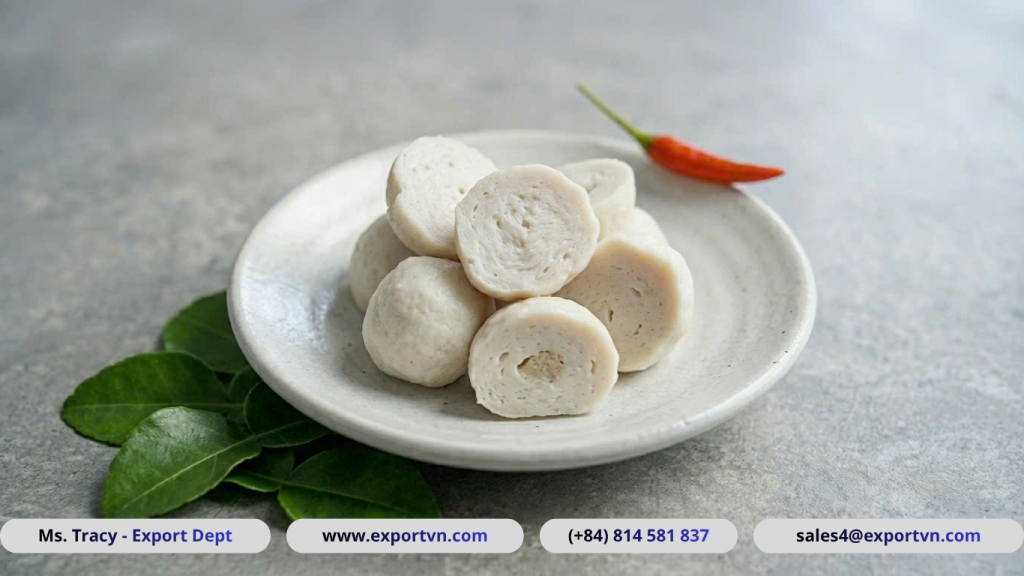
In real R&D workflows, E1412 modified tapioca starch serves as a reference point. Specifically, manufacturers use it to establish baseline texture, measure elasticity and water retention, and compare performance with alternative starches.
This structured approach helps reduce development time and minimize technical risks.
Recommended Testing Procedure
Testing E1412 samples is a crucial step before scaling up production. To obtain reliable results, manufacturers typically:
- Use 3%–5% E1412 in the formulation
- Mix thoroughly with fish paste (surimi)
- Cook under actual processing conditions
- Evaluate texture, elasticity, and water release
- Conduct freeze-thaw testing for stability
Key Considerations for Optimization
To maximize performance, it is important to adjust dosage based on fish protein content. Combining E1412 with salt and phosphates can further enhance texture and stability.
Moreover, comparative testing with other starches is also recommended to refine the final formulation.
Applications and Why Choose EXPORTVN
Manufacturers widely use E1412 in fish balls, surimi products, seafood sausages, and processed meat products.
EXPORTVN provides stable quality INS E1412 / DISTARCH PHOSPHATE, strong technical support, fast sample delivery, and export experience in more than 25 countries—making it a trusted partner for global customers.
Conclusion
Fish ball manufacturers request E1412 modified tapioca starch first because it delivers reliable texture performance, high yield efficiency, and excellent processing stability.
In practical terms, E1412 is the most dependable starting point for fish ball formulation and product development.
Visit one of Vietnam’s leading, high-capacity cassava starch factories with EXPORTVN
Contact for inquiries and business cooperation:
Ms. Tracy – Global Sales Executive
WhatsApp/Zalo: (+84) 814 581 837
Email: sales4@exportvn.com
Or visit our Contact page.

Pingback: Кто производит модифицированный крахмал Баффало?
Pingback: बफ़ेलो ब्रांड संशोधित टैपिओका स्टार्च का निर्माता कौन है?