


Common types of modified starch, Properties of starch
What Is Oil-Treated Modified Starch? Uses, Benefits and Food Applications
Jul
Food manufacturers constantly look for ingredients that improve product quality while supporting efficient production. Among these functional ingredients, oil-treated modified starch has become a valuable solution for enhancing the texture, crispiness, and stability of many processed foods. Unlike conventional starches that mainly provide thickening, this specialty ingredient offers multiple functional benefits during food processing and in the final product.
At EXPORTVN CO., LTD, we work closely with food manufacturers worldwide to supply functional tapioca starch solutions for coating systems, fried foods, and processed food applications. Through years of experience in the food ingredient industry, we understand how selecting the right starch can improve both product quality and production efficiency.
In this article, you’ll learn what oil-treated modified starch is, how it works, its key benefits, and its most common food applications.
What Is Oil-Treated Modified Starch?
Definition and Manufacturing Process
Oil-treated modified starch is a type of modified food starch that undergoes an additional treatment with food-grade vegetable oil or edible lipids to improve its functional properties. Manufacturers develop this ingredient to deliver better performance than native starch, especially in applications that require high heat, strong coating adhesion, and stable texture.
Unlike native starch, which mainly thickens or gels during cooking, oil-treated modified starch interacts more effectively with water, oil, proteins, and food surfaces. Consequently, it performs well in coating systems and fried foods where texture and processing stability are essential.
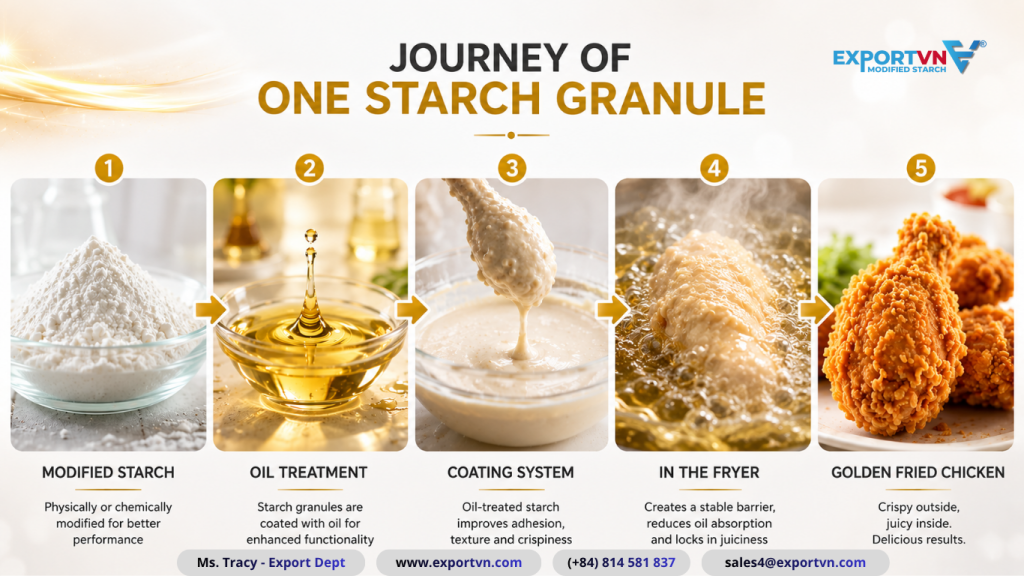
The production process usually begins with modified starch, which already has improved resistance to heat, mechanical shear, or acidic conditions. Manufacturers then apply a controlled oil treatment that changes the starch’s surface characteristics. As a result, the starch disperses more uniformly, adheres better to food surfaces, and creates a stronger coating during frying.
Although manufacturers use different processing technologies, they share the same objective: to improve the functional performance of starch in demanding food applications.
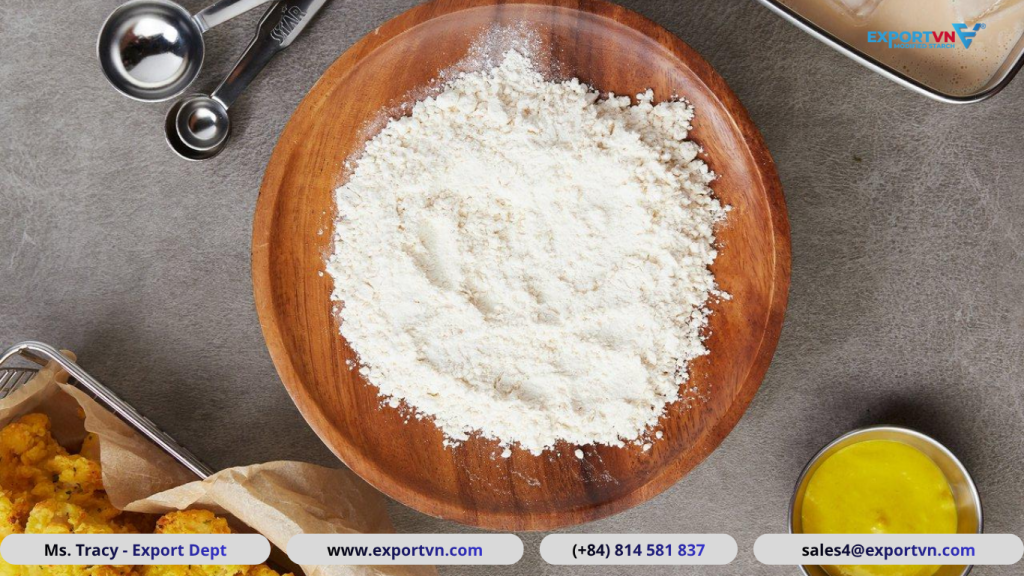
How Does Oil-Treated Modified Starch Work?
During frying, moisture inside the food rapidly turns into steam while the coating begins to set. At the same time, this functional starch forms a thin protective film around the food surface.
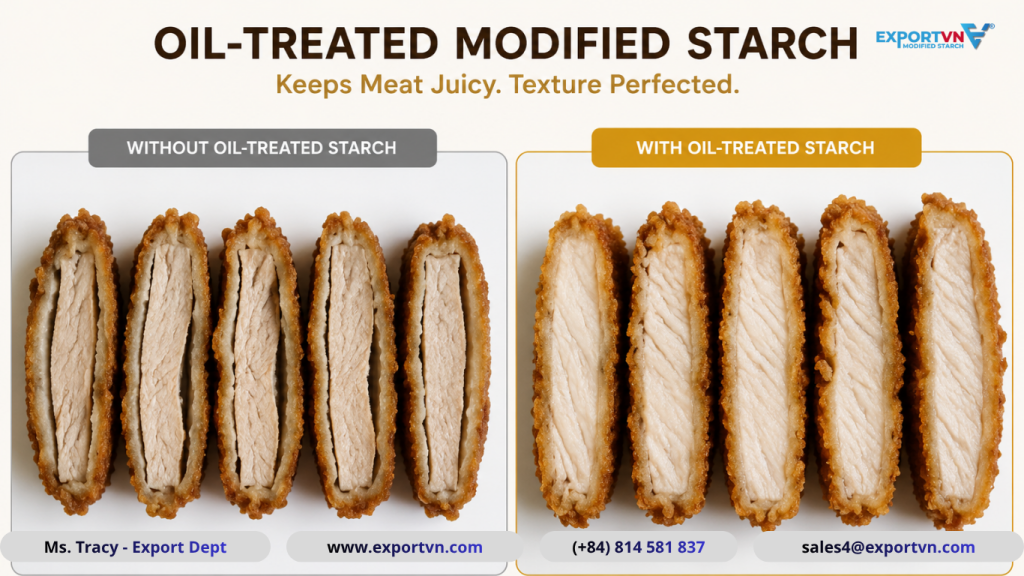
This film performs several important functions. First, it slows excessive oil absorption, helping reduce the amount of oil that enters the product. Meanwhile, it limits moisture loss, allowing the food to remain juicy inside while developing a crispy outer layer.
In addition, the starch strengthens the structure of the batter or breading. Therefore, coatings adhere more firmly and resist cracking, peeling, or separation during frying, freezing, transportation, and reheating.
Furthermore, the ingredient promotes more even browning and a smoother coating surface. As a result, manufacturers can consistently produce foods with an attractive golden color, uniform texture, and excellent eating quality.
Key Benefits of Oil-Treated Modified Starch
Performance Benefits During Food Processing
One of the greatest advantages of oil-treated modified starch is its ability to improve manufacturing efficiency without compromising product quality.
First, it significantly improves coating adhesion. Batters and breadings bond more effectively to meat, seafood, vegetables, and plant-based proteins, reducing coating loss throughout production.
Second, it helps control oil uptake during frying. Because the protective starch layer limits excessive oil penetration, finished products become less greasy while maintaining their desired texture.
Moreover, this ingredient performs consistently under industrial processing conditions. It withstands high temperatures, continuous mixing, and mechanical processing more effectively than native starch. Consequently, manufacturers experience fewer processing issues and achieve more consistent production results.
Another important advantage is its excellent freeze-thaw stability. Frozen coated products maintain coating integrity after storage and reheating, which improves both manufacturing efficiency and consumer satisfaction.
Benefits for Finished Food Products
The functional advantages of this modified starch continue after production, improving the overall quality of finished foods.
One of the most noticeable benefits is enhanced crispiness. Foods develop a lighter, crunchier coating that remains crispy for a longer period after frying or reheating.
At the same time, the starch helps retain internal moisture. Consequently, fried foods maintain a juicy, tender interior instead of becoming dry or tough.
In addition, the ingredient contributes to a more uniform golden appearance. A smoother coating with fewer cracks or broken areas creates a more attractive finished product.
Finally, better texture, lower greasiness, and improved appearance deliver a more enjoyable eating experience. Therefore, manufacturers can offer products that meet consumers’ growing expectations for premium-quality fried and convenience foods.
Food Applications of Oil-Treated Modified Starch
Fried and Coated Foods
Because of its excellent frying performance, oil-treated modified starch is widely used in many fried and coated food applications.
For example, manufacturers use it in fried chicken to produce a crispy coating while keeping the meat moist and tender. Likewise, breaded seafood, fish fillets, tempura, and onion rings benefit from improved coating adhesion and reduced oil absorption.
The ingredient also performs well in French fries, helping create a crispier surface while maintaining texture after holding or reheating.
In batter and breading systems, oil-treated modified starch improves coating consistency, reduces breakage, and enhances the overall appearance of fried products. As a result, food manufacturers achieve higher production yields and more consistent product quality.
Processed and Convenience Foods
Beyond fried foods, oil-treated modified starch also supports a wide range of processed food applications.
Frozen products such as chicken nuggets, croquettes, fish sticks, and ready-to-cook meals benefit from improved coating stability and better texture after reheating. Since the starch helps maintain product integrity during freezing and thawing, manufacturers can deliver more consistent quality throughout the product’s shelf life.
Snack manufacturers also incorporate this functional ingredient into crackers, coated nuts, chips, and extruded snacks to improve crunchiness and texture consistency.
Furthermore, the ingredient supports innovation in modern convenience foods by helping manufacturers develop products with excellent sensory quality while maintaining efficient industrial production.
Conclusion
Oil-treated modified starch is an effective functional ingredient that helps improve coating adhesion, crispiness, moisture retention, and oil absorption control in a variety of food applications. Thanks to its reliable performance during frying, freezing, and reheating, it has become a preferred choice for manufacturers producing fried foods, coated products, snack foods, and frozen convenience meals.
At EXPORTVN CO., LTD, we are committed to providing high-quality tapioca starch and Modified Tapioca Starch solutions that meet the diverse needs of the global food industry. Backed by technical expertise and reliable supply, we help food manufacturers select the right starch solution to enhance product quality, optimize processing performance, and support successful product development.
Contact for inquiries and business cooperation:
Ms. Tracy – Global Sales Executive
WhatsApp/ Mob: (+84) 814 581 837
Email: sales4@exportvn.com
