


Common types of modified starch
Modified Starch for Salad Dressing
Mar
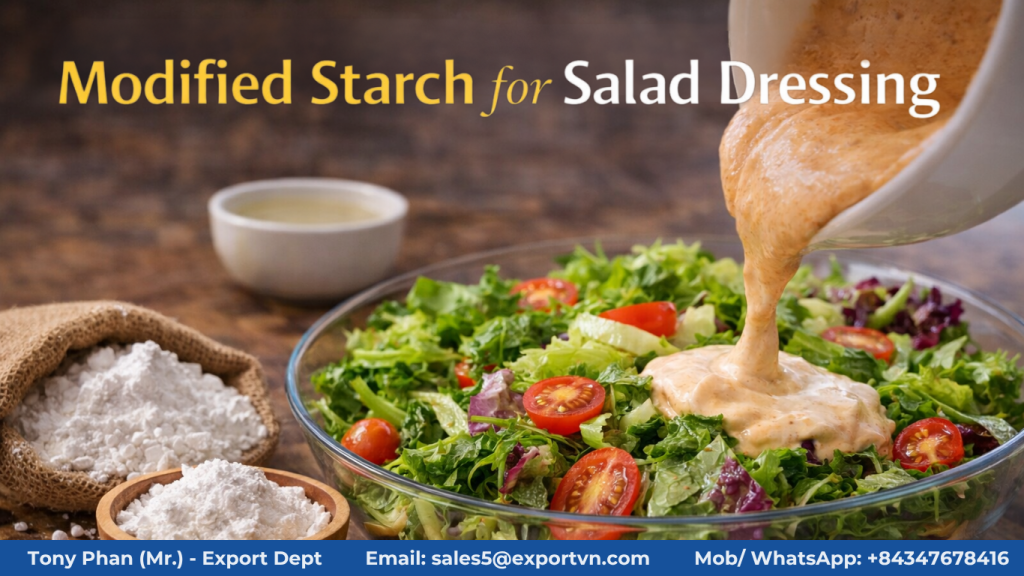
Modified starch for salad dressing plays an important role in creating smooth texture, stable viscosity, and better product consistency. As a reliable salad dressing stabilizer, it helps manufacturers improve emulsion performance and shelf-life quality. In many cold-process applications, modified food starch in salad dressing is used to build body, reduce separation, and support a creamy mouthfeel without cooking.
Salad dressing needs more than flavor to succeed in the market. It also needs the right texture, flow, and visual appeal. A well-selected modified starch system helps achieve these goals. For cold-process products, this is especially important because the formula must perform well without heat.
Contact us now:
Tony Phan (Mr.) – Senior Sales Executive
📧 Email: sales5@exportvn.com
📞 Mob/WhatsApp: +84 347 678 416
1. Why Cold-Process Modified Starch for Salad Dressing Is Important in Salad Dressing Formulation
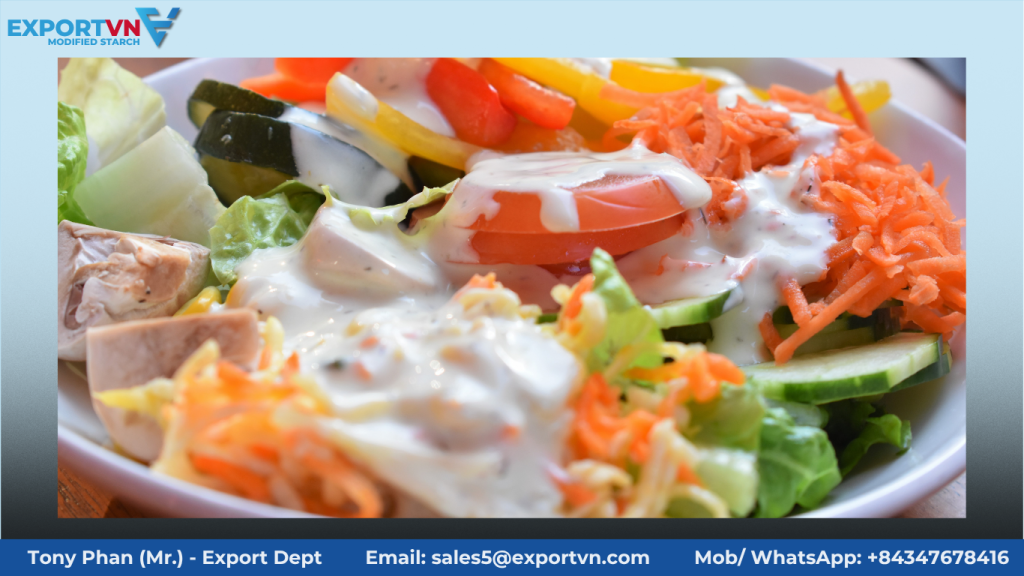
Cold-process systems are widely used because they are simple and efficient. They reduce processing time and make production more flexible. This is why modified starch for salad dressing has become a practical choice in many formulations.
Instant Texture and Viscosity Development
One major benefit of cold-process starch is fast viscosity development. It builds thickness quickly at room temperature and helps create a smooth, creamy texture.
This is useful for both light and rich dressings. Manufacturers can control body more easily and reach the desired mouthfeel without adding a cooking step. In this way, modified tapioca starch supports product quality from the first stage of mixing.
Better Emulsion Stability in Cold-Mixed Systems
Salad dressing is usually an oil-and-water system, so emulsion stability is critical. Without proper support, the product may separate during storage.
A good modified starch solution helps keep the mixture uniform. It reduces oil separation and supports a smoother, glossier appearance. This improves shelf appeal and gives the final product a more consistent look.
Efficiency in Cold-Process Production
Cold-process production is attractive because it saves time and simplifies operations. Starch that works well in this system can improve workflow and reduce production complexity.
It is suitable for formulations that do not require heat. It also performs well in high-shear mixing and homogenization. For this reason, modified starch for salad dressing is often preferred in modern dressing production where efficiency matters.
Stable Quality During Storage
Shelf-life stability is another important factor in dressing formulation. The product should keep its texture and appearance over time.
Cold-process starch helps maintain viscosity during storage. It also supports texture stability in acidic systems and may improve appearance under refrigerated conditions. These benefits make it easier to deliver a reliable product to the market.
2. How to Choose the Right Cold-Process Modified Starch for Salad Dressing
Choosing the right starch depends on the product target. Texture, viscosity, acidity, and dosage all affect the final result. A suitable starch should match both formulation goals and processing conditions.
Selecting Starch Based on Dressing Type
Different dressings need different performance profiles. Creamy dressing needs a fuller body and smoother mouthfeel. Low-fat dressing needs better texture compensation because it contains less oil. Acidic dressing also requires stronger stability.
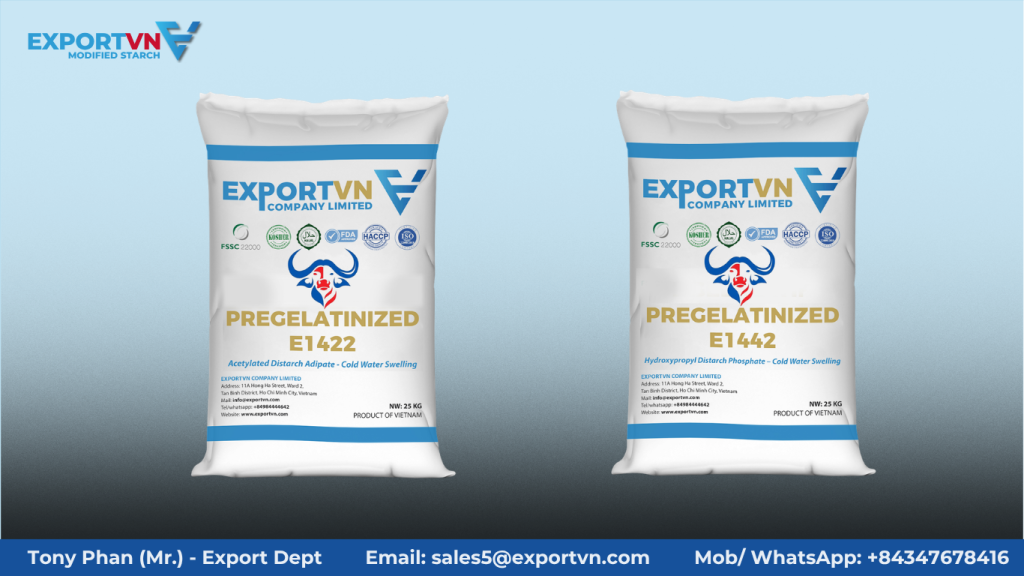
In all three cases, Modified Tapioca Starch E1442 Pregelatinized is a suitable choice. It works well in cold-process formulations, helps improve texture in creamy and low-fat dressings, and supports stability in acidic systems.
Besides Modified Tapioca Starch E1442 Pregelatinized, Modified Tapioca Starch E1422 Pregelatinized can also be considered as a cost-optimized solution. It is suitable for formulations that need a good balance between performance and cost efficiency.
Practical Application and Dosage Considerations
Dosage should be selected based on the target viscosity and mouthfeel. In many cases, the recommended use level is around 4 – 5%.
Lower use levels may be suitable for pourable dressings. Higher use levels may work better for spoonable or creamier products. The right level depends on the full recipe, including oil content, acid level, and other stabilizing ingredients.
Trial batches are important before scale-up. They help confirm texture, flow behavior, and product stability. This step also helps manufacturers adjust cost and performance more effectively. In many formulations, modified tapioca starch can be adjusted to meet different texture targets.
3. EXPORTVN – Modified Tapioca Starch Supplier from Vietnam
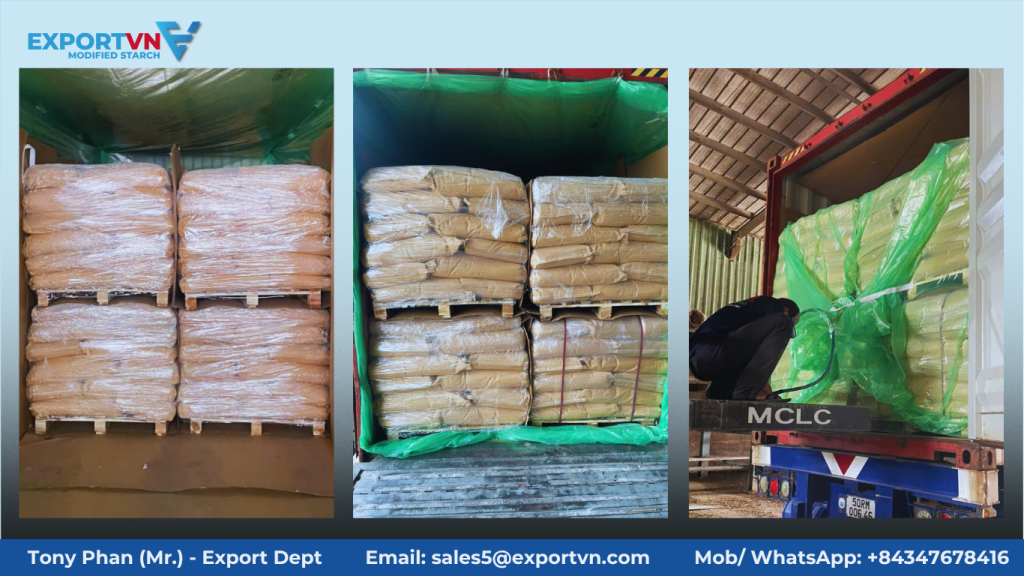
For businesses seeking a reliable and high-quality source of Modified Tapioca Starch, ExportVN stands as a leading supplier of Tapioca Starch in Vietnam. Opting for ExportVN offers several distinct advantages:
- Customized Packaging: We support various packaging options and ODM under your label.
- Competitive prices: Prices are based on production costs, so they are sure to fit your budget.
- Expert advice: We have a team of experienced professionals who can help you choose the right modified tapioca starch for your needs.
- Lead time: We offer a competitive lead time of approximately 2 weeks.
- Customization: We can adjust product parameters to meet your precise requirements for tapioca starch.
- Flexible Ordering: You can conveniently mix 2-3 different starch products in a single order.
Conclusion
Modified starch for salad dressing is a practical solution for improving texture, emulsion stability, and cold-process efficiency. It helps create smooth and stable products while reducing processing complexity. With the right choice of modified starch, especially for creamy, low-fat, or acidic systems, modified starch for salad dressing can support better product quality and more consistent commercial results.
Contact us now:
Tony Phan (Mr.) – Senior Sales Executive
📧 Email: sales5@exportvn.com
📞 Mob/WhatsApp: +84 347 678 416
